A (mini) guide to selecting fiber content in a yarn

Have you ever knit a beautiful alpaca scarf and said, “Gee, I like it… but I didn’t know it’d be so warm!” Every yarn fiber has different properties that make it soft/warm/itchy. So, it’s worth learning a bit about the fibers before starting a project!
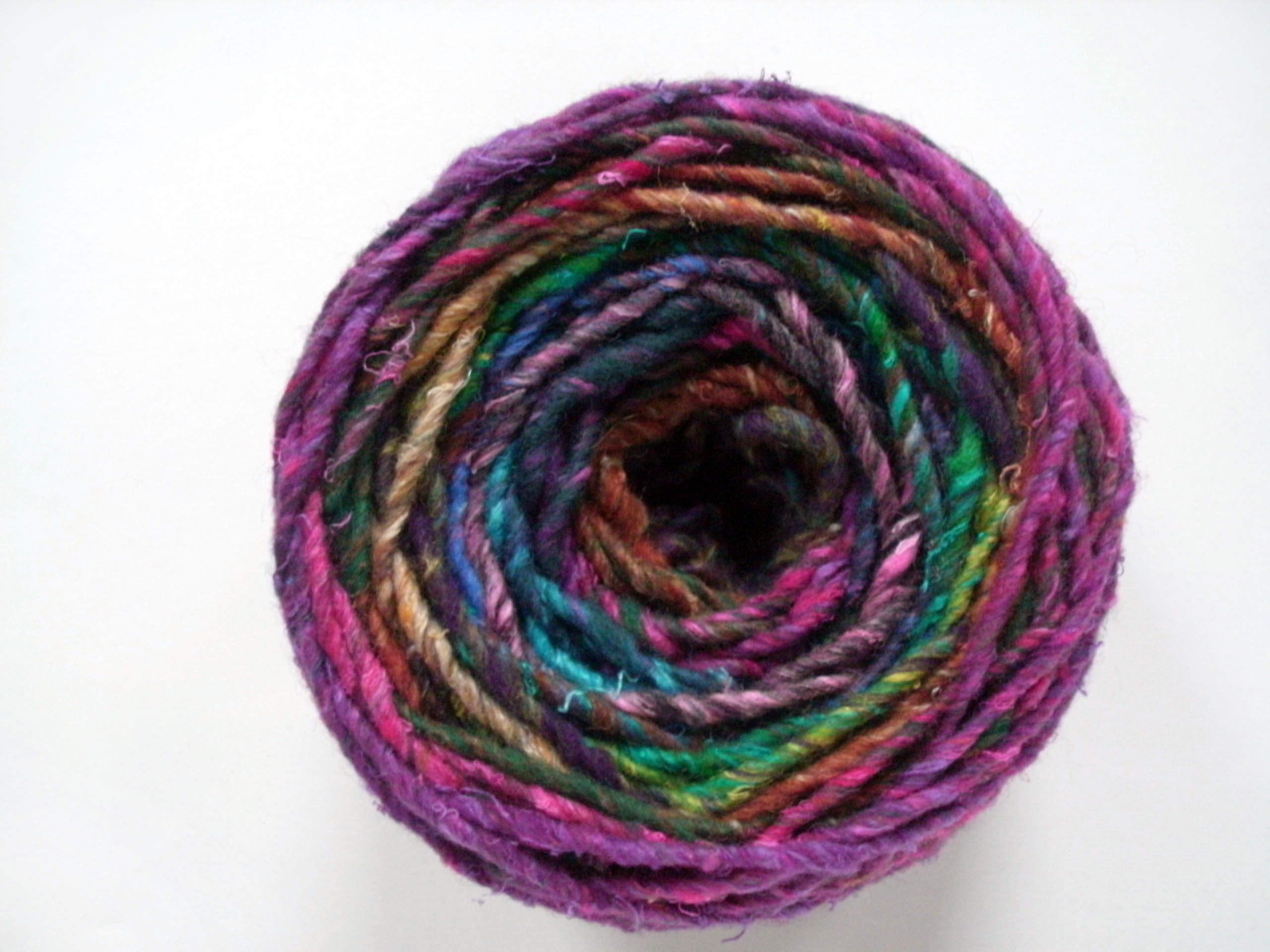
It’s impossible to give you all the info you need to know about yarn fibers in one little blog post… in fact, whole books have been written on the topic!

For more information about how fibers and properties of the yarn (single ply, thickness, etc) affect your final project, I highly recommend The Knitter’s Book of Yarn: The Ultimate Guide to Choosing, Using, and Enjoying Yarn. There’s also a fabulous section all about fiber properties in The Knitter’s Life List – definitely worth getting if you’re looking for more info!

Wool

Ah, our friend wool! We’ve all heard of it, and for a lot of people, wool has a bad reputation for being itchy and allergy-causing. While there are some folks with a genuine allergy to wool, wool-allergies are pretty rare. Chances are, the person has a sensitivity to coarse wool fibers. And who can blame them… no one likes an itchy sweater!

If you were made to wear a wool sweater in the 80’s as part of your school uniform (like my poor hubby), you probably have horrible nightmares about the itch factor… but fear not! Not all wool is itchy!
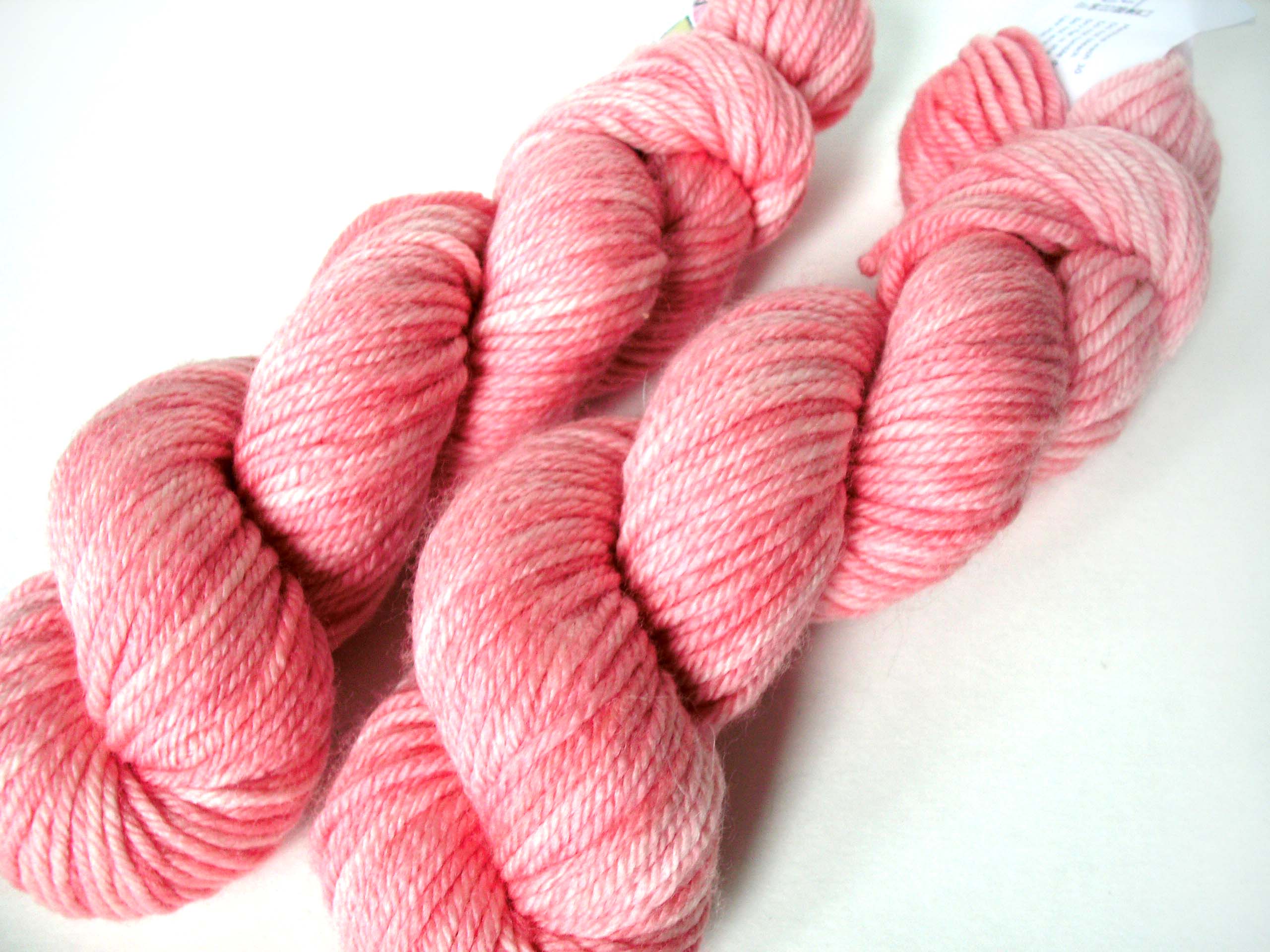
Different sheep breeds produce wool with different (staple) lengths of fiber and courseness. Coarser and longer fibers (in general) are scratchier, but more durable and water-resistant. Shorter fibers (heard of Merino?) are oh-so-soft, but prone to pilling and need to be handled more gently.

In general, wool needs to be hand-washed (because too much agitation will cause the yarn to felt). However, there are some ‘super-wash’ wool yarns available on the market: yarns where the wool fibers have been treated to prevent felting. These super-wash yarns are a great choice for baby items!

If you want to use natural fibers for an amigurumi project, wool is a great choice for any of my patterns.

To try:

Alpaca

An alpaca is a cousin of the llama, and some breeds have incredibly soft fiber. Alpaca is warmer than wool, but has a tendency to be a little bit prickly.
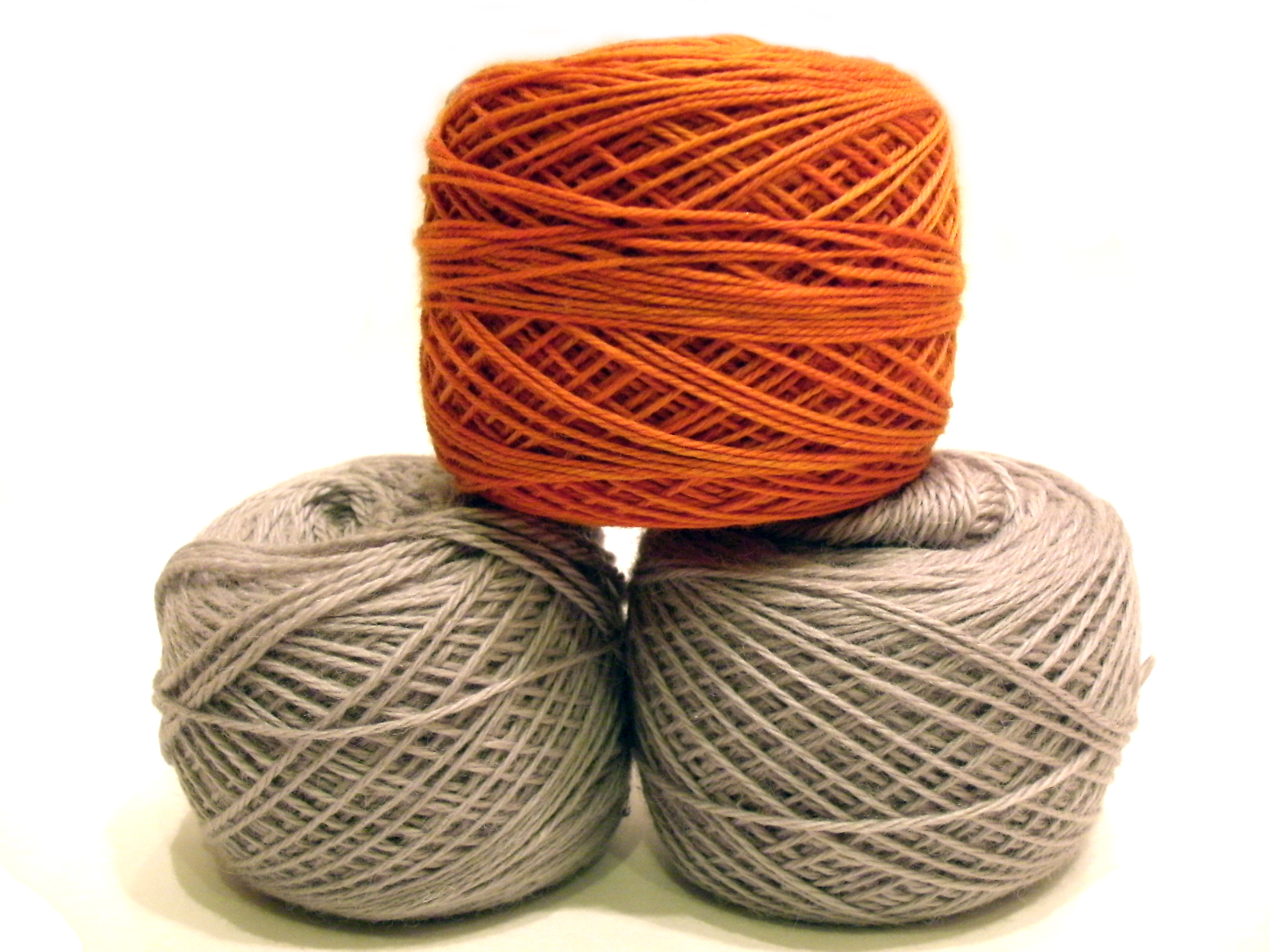
Alpacas come in a wide range of colors, and the yarns available on the market reflect this wide color range.

To try:

Cotton

You’ve heard the song, right? The fabric of our lives…

I totally love cotton! Some cottons are incredibly soft (there are different breeds of cotton just like there are breeds of sheep!) and items made from cotton are lightweight and cool, partially because of cotton’s ability to absorb water (and sweat). However, cotton is much less elastic than wool, so it’s best to select projects designed to be made with a cotton that take into account its lack of elasticity.

Cotton naturally comes in a range of colors, although commercially produced yarns in the tans and greens are becoming harder and harder to find due to a difficulty in sourcing the raw product.

Typical cotton production requires a very heavy use of pesticides, so organic cotton yarns are worth investigating.

To try:

Silk

Yummy! Silk is made from the cocoon of a silkworm… a single thread can be hundreds of feet long!

Silk is incredibly soft, takes dye amazingly and has the superb ability to keep you warm when it’s chilly and cool when it’s hot.

Traditional silk production involves killing the larvae inside the cocoon, which is necessary to unravel one continuous thread of (highly desirable) silk. ‘Peace Silk’ is made by letting the larvae emerge from the cocoon before harvesting the silk threads. This results in shorter threads, but a live silkworm.

In yarn, silk is often blended with another fiber (like wool) to produce a yarn with a combination of elasticity and shine.

Other fibers

Oh, I’ve hardly scratched the surface! There’s yarn from bison, possum, corn, soy, banana silk… even crab shells! And each yarn fiber has its own exciting collection of properties!
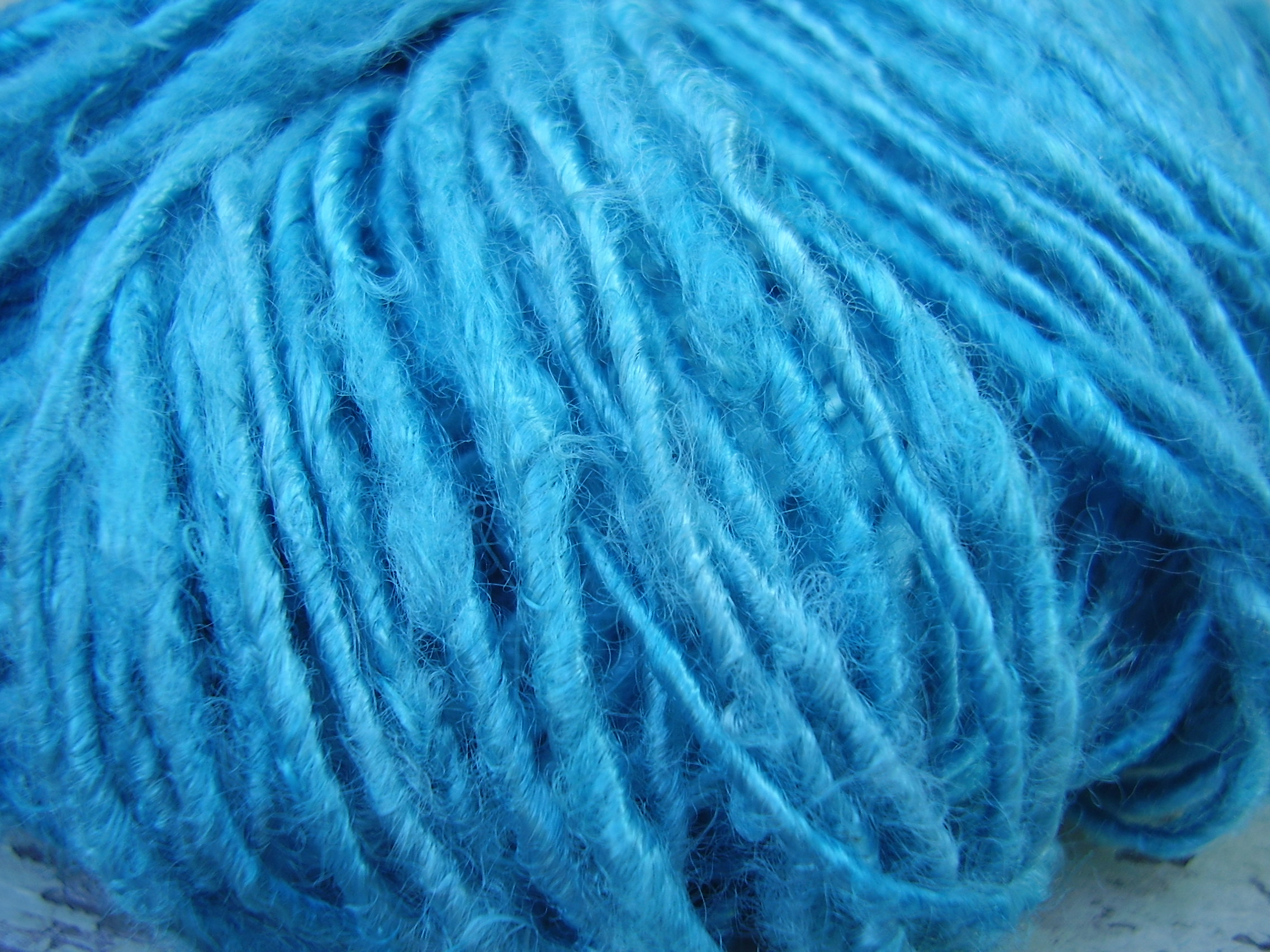
So, even though I haven’t had time to chat about them all, I hope I’ve encouraged you to give a different fiber a try… and have given you a little more information that you can use before starting your next project!

How Do I Embroider on Quilts?

Blue and pink embroidery thread on cream fabric with needle, how to embroider on quilts.

Brightly colored quilt with playful patterns on a cozy bed.

Want to learn the basics of hand embroidery with an easy online workshop – totally free?

Sign up for Embroidery 101 here. You’ll learn how to get started, the tools and supplies you’ll need, the four most basic stitches, how to transfer your pattern and how to display your work.

If you already know the basics – sign up for Embroidery 201. It’s also free! You’ll learn how to stitch on specialty fabrics like felt and stretchy T-shirts. Plus you’ll learn lots and lots and LOTS more stitches – all my favorites!

Brightly colored quilt with playful patterns on a cozy bed. I have a question–I just bought your bird sampler pattern and I want to include them in pairs around a quilt that I am making. Β I have the top finished and I was wondering–what do you recommend–embroidering before I make the quilt sandwich, and then do the actual quilting–stitch in the ditch etc, or do you think it is better to do the embroidering as actual hand quilting and pull it all the way to the back. Β I am not sure, as I haven’t embroidered on any of the quilts I have made. The quilt is a combo of flying geese and Chinese coins patterns and the focus fabric has chattering birds on a telephone line–so I think random pairs of embroidered birds will be great. Β Thanks for your help with this question!!

Sandy emailed me a while ago with this question. As is almost always the case – my answer is longer than you might expect. (I ended up doing a full-blown tutorial showing you how to start and stop without knots, hide your tails, and carry thread invisibly from place to place. Keep reading and you’ll get there.) I’ve actually done both methods – and like them both – but they do look very different. So. . . it depends. . .

It depends on what design you want to stitch, what stitch you’ll be using, and how much interior detail there is.

I thought the best way to illustrate this would be to show the backs of some of my embroidered pieces.

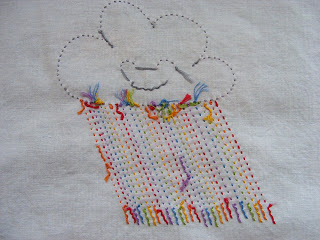
Cloud embroidery design with rainbow-colored rainbow threads, cheerful and playful pattern, perfect for children's clothing and accessories.

Running stitch looks the same back and front – so it’s a good candidate for something you’ll see from both sides. Read on and I’ll share a tutorial for hiding your threads when you carry from place to place (like between the eyes and mouth).

Backstitch doesn’t look bad either. It’ll be chunkier on the back than on the front, but with some care on your carrying and hiding thread tails, it can look pretty good.

Notice – what the image above has is nice, simple, open shapes. Not a lot of detail. Now for the opposite. . .

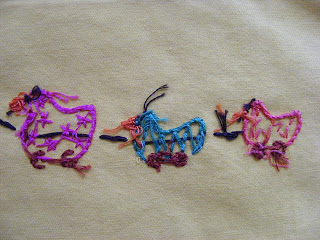
Aaaaack! Run away! This is quite ugly from the back – and that’s because the shapes are filled with cute chain stitches, French knots, and lazy daisies. Here’s another. . .

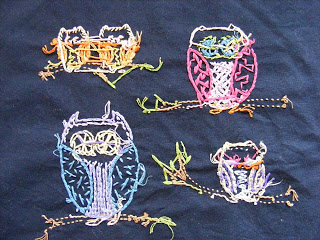
Again, this one has lots of detail inside the main shapes and it looks bad, bad, bad from the back.

So, quilting first and then embroidering through all three layers can be nice. Choose a nice, simple shape to stitch and stitch it in running stitch, backstitch, or split stitch. The quilt will “puff” nicely around the stitching and in the larger open areas of the design.

If you want to do some fancier embroidery – like the owls or the birds – embroider first and then layer and quilt. Otherwise the embroidery will be hideous from the back – and it will also compress the layers of your quilt too much and can distort the whole lay of things.

So – about that carrying? I said if you’re careful with carrying your thread and hiding your tails you can have something that looks pretty nice. Well, I ended up doing a full-blown tutorial on this.

Β Here begins the tutorial

This is a quilt sandwich, ready for quilting. Instead of the usual quilting thread, I’m going to embroider one pink line with running stitch, and the other with backstitch and split stitch. I’ll use 4 strands of embroidery thread. I won’t use any knots, there will be no hanging tails, and you won’t see the thread carried from one line to the other. Ready to learn some sneaky magic?

Start by inserting your needle about an inch from where you want to start stitching. The needle goes in just through the top layer of fabric, then travels between the two layers of fabric (and the batting) until I bring it up where I want to start visible stitching. So if I flipped this over right now you wouldn’t see any needle (or thread) at all from the back.

Pull the thread until the tip of the tail just disappears into the starting hole your needle made. Careful! Don’t pull it all the way through!

Now – take a tiny stitch through all layers. This is going to secure the thread instead of a messy knot.

Bring the needle back up through the start of that tiny stitch. I should have photographed this better, but that needle is pointing up.

Now the thread is coming back up at the original desired starting point. There’s no knot, but that tiny stitch is holding it in place. You can yank really hard on this and it’s not coming loose. The tail of the thread is buried in the batting between the two layers of fabric. Neat!

OK. I stitched a whole bunch of running stitches and I’m ready to jump over to the other line. But I don’t want anyone to be able to see the thread between the two lines! So I get sneaky again and thread the needle between the two layers of fabric, right there in the batting. Easy peasy! The only drawback is that you can’t carry the thread any farther than the length of your needle. (Actually, there is a way. But I find it so tedious and irritating to do that I’d rather just tie off here and start over in the new space.)

OK. I did some more stitching. Some backstitches and then some split stitches. Now I’m ready to tie off. I take another tiny stitch. See how the needle is coming up really close to the end of that stitch? I’m talking that tiny of a stitch. Tiny is what makes it tight and work like a knot.

I put the needle back in at the end of the stitching (really close to where it came up – remember – tiny!) but only through the top layer of fabric. Carry your tail through the batting for about an inch, then bring the needle back up and out.

There’s the thread tail, veering up off the top, waiting to be cut.

Snip it off really close to the surface of the fabric. Careful! Don’t cut your fabric. It’s ok if a tiny bit of thread shows above the surface.

Rub your finger over it once and it will pop right into the batting and disappear from the front.

So here’s the finished stitching from the front. That’s running stitch on top, backstitch on the lower left, and split stitch on the lower right.

And here they are from the back. Again – running stitch on top, but now the back of the backstitch is in the lower right and the back of the split stitch is in the lower left.

No knots, no tails, and no thread carries. Neat and tidy. πŸ™‚

Whew! That answer was even longer-winded than I expected. And I know how I can be. πŸ™‚Β  I hope you all find it helpful!

Best,
Wendi
Brightly colored fabric with playful patterns, perfect for making cheerful, DIY sewing projects.

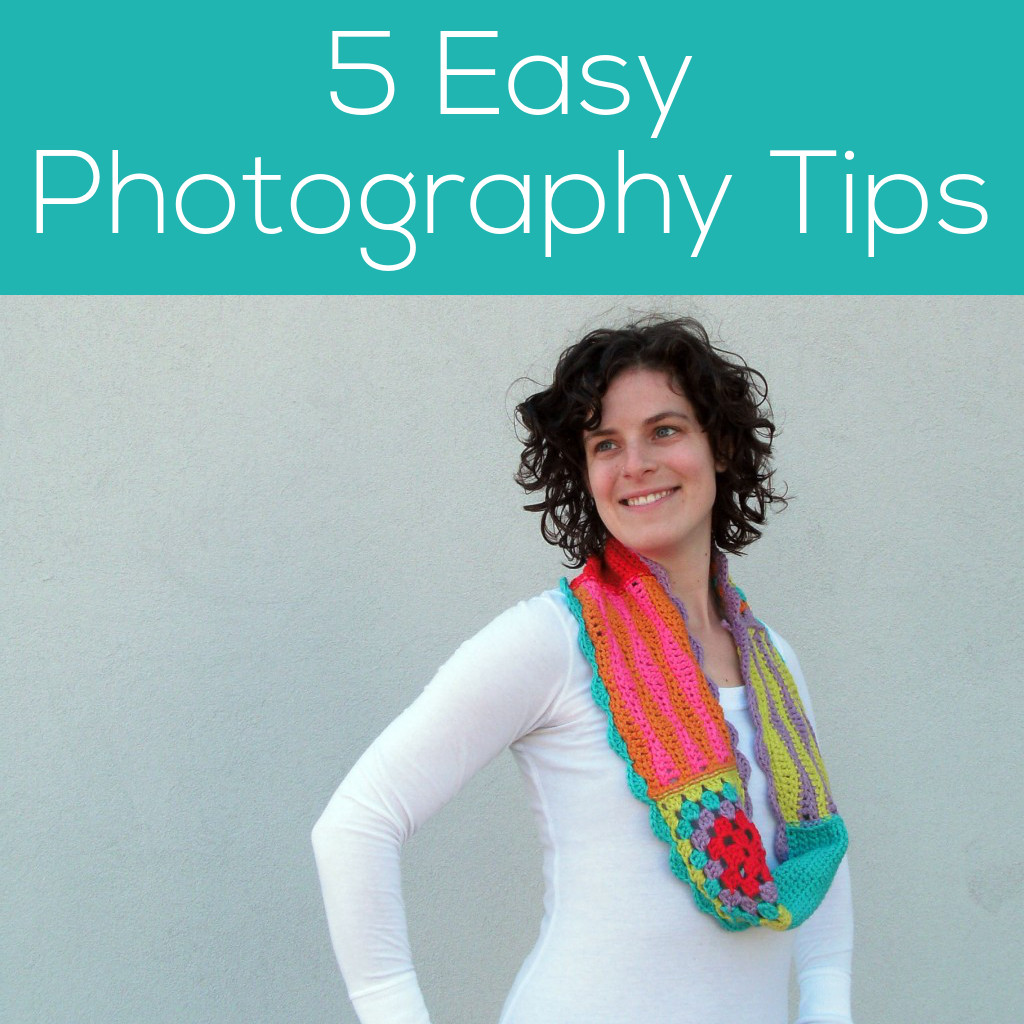
5 Easy Photography Tips

5 easy photography tips from FreshStitches and Shiny Happy World

If you’re like me, you’re a crafter… and NOT a photographer! But, you still want to take nice photos of your completed projects for your blog or to share on Ravelry. Help is here! In this blog post, Stacey and I share share 5 easy photography tips you can use to take lovely project photos, without lots of fancy equipment.

No fancy equipment needed!

The most common misconception about taking nice photos is that you need to have a super-fancy camera to do so. But you don’t! You can take fabulous pictures with a point-and-shoot-camera and having a few tricks up your sleeve. Nowadays I use my phone for all my photography.

So, what are these photography tips? Let’s get started!

Tip 1: Use Natural Light

I can’t say enough about the fabulous sun! To take beautiful photos, you want to find a well-lit area that’s not in direct sunlight.

For outside photos, this means picking a time of day that’s not noon – directly in the sun means lots of glare and harsh shadows. For best results, choose a day that’s slightly overcast. Those clouds filter the light and make everything perfect.

For inside photos, I use a spot next to a window that has loads of light flooding through. So I don’t get harsh shadows, I use a couple of pieces of foam core to bounce the light around.

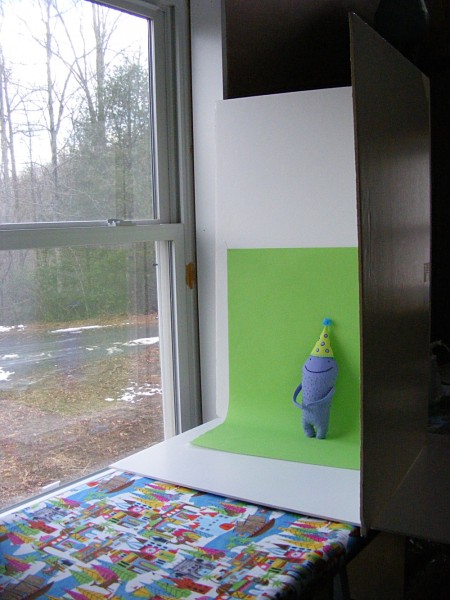
Here’s a shot of my “tall” set-up. I use this set-up to photograph stuffed animals from the front.

Sculpted fabric doll with a party hat standing on green paper backdrop.

It’s just two pieces of foam core taped together to make a hinge so I can stand them up.

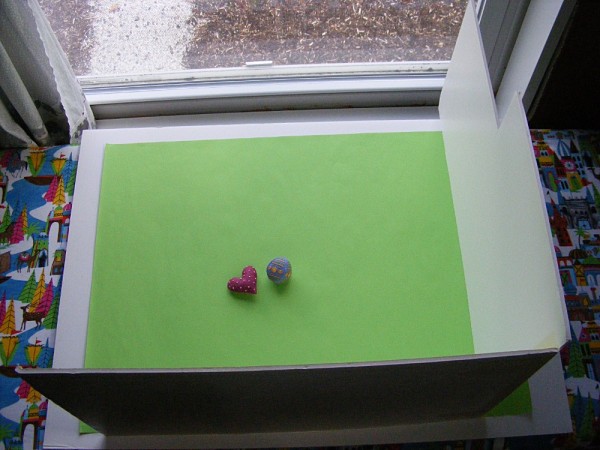
When I shoot a flat lay (looking it everything from straight above) I do the same thing, just with shorter pieces of foam core so I can see over them.

A Peek at My Photography Set-Up - Shiny Happy World

I stand on a step-stool to be able to shoot straight down.

Tip 2: Use White Posterboard for the ‘Clean’ Look

I used to think that I needed a photographer’s tent and all sorts of fancy equipment to get that fabulous white background, but now I know that you don’t!

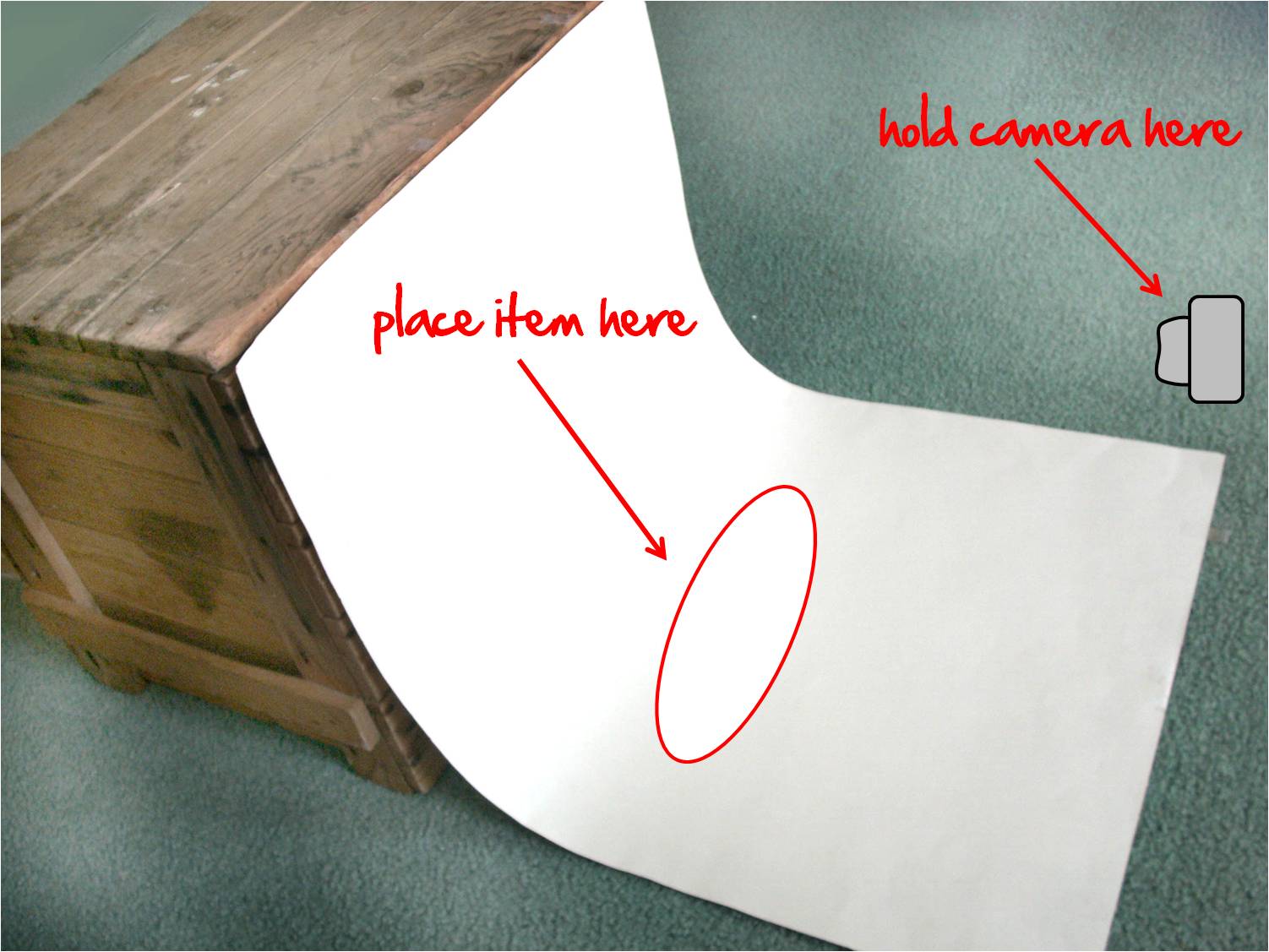
Here’s how Stacey uses a white piece of posterboard, propped up against a wooden box that she found by the side of the road.

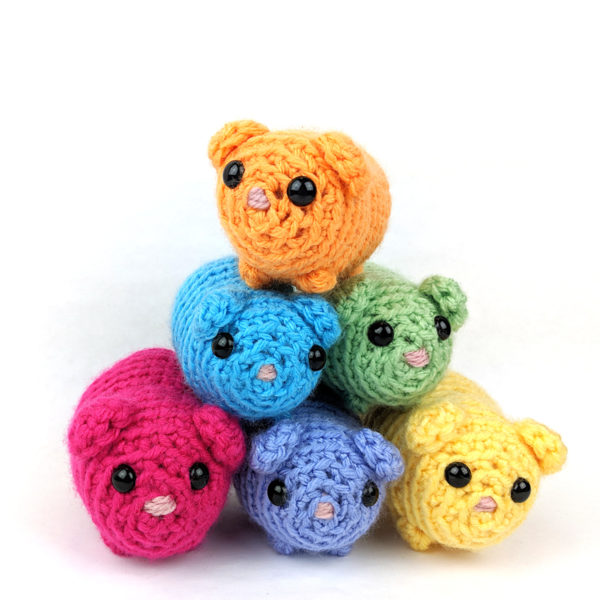
Using the posterboard allows you to get a white background for photos like this. . .

pyramid of crocheted rainbow guinea pigs

I prefer to have colored backgrounds like this. . .

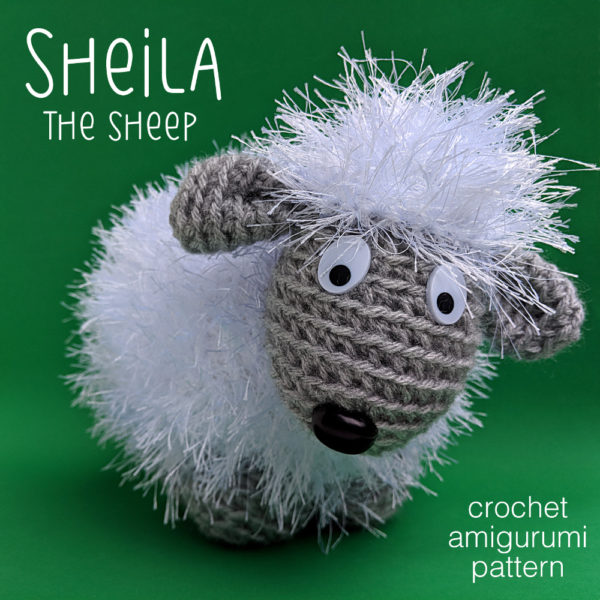
Cute crochet sheep amigurumi pattern, handmade toy, wool yarn, DIY craft, stuffed animal, gift idea.

So I use a large sheet of paper the same way Stacey uses the white posterboard. I pins my paper to those foamcore light bouncers.

Tip 3: Get a Tripod

I said ‘no fancy equipment’… but Stacey highly recommends this Joby Gorillapod Tripod.

She loves it for two reasons. The first reason is that the Gorillapod is magnetic and has bendable arms, which means that she can stick it on a stop sign/pole and take self-portraits.

But that’s not all! A tripod is also really useful in low lighting. When there isn’t a lot of light, the camera lens needs to stay open longer to get enough lighting… meaning that any shake of your hand will make a blurry photo. By having a tripod, you can be sure that the camera stays still, and take photos even when your natural light is fading.

Tip 4: Take Lots of Photos!

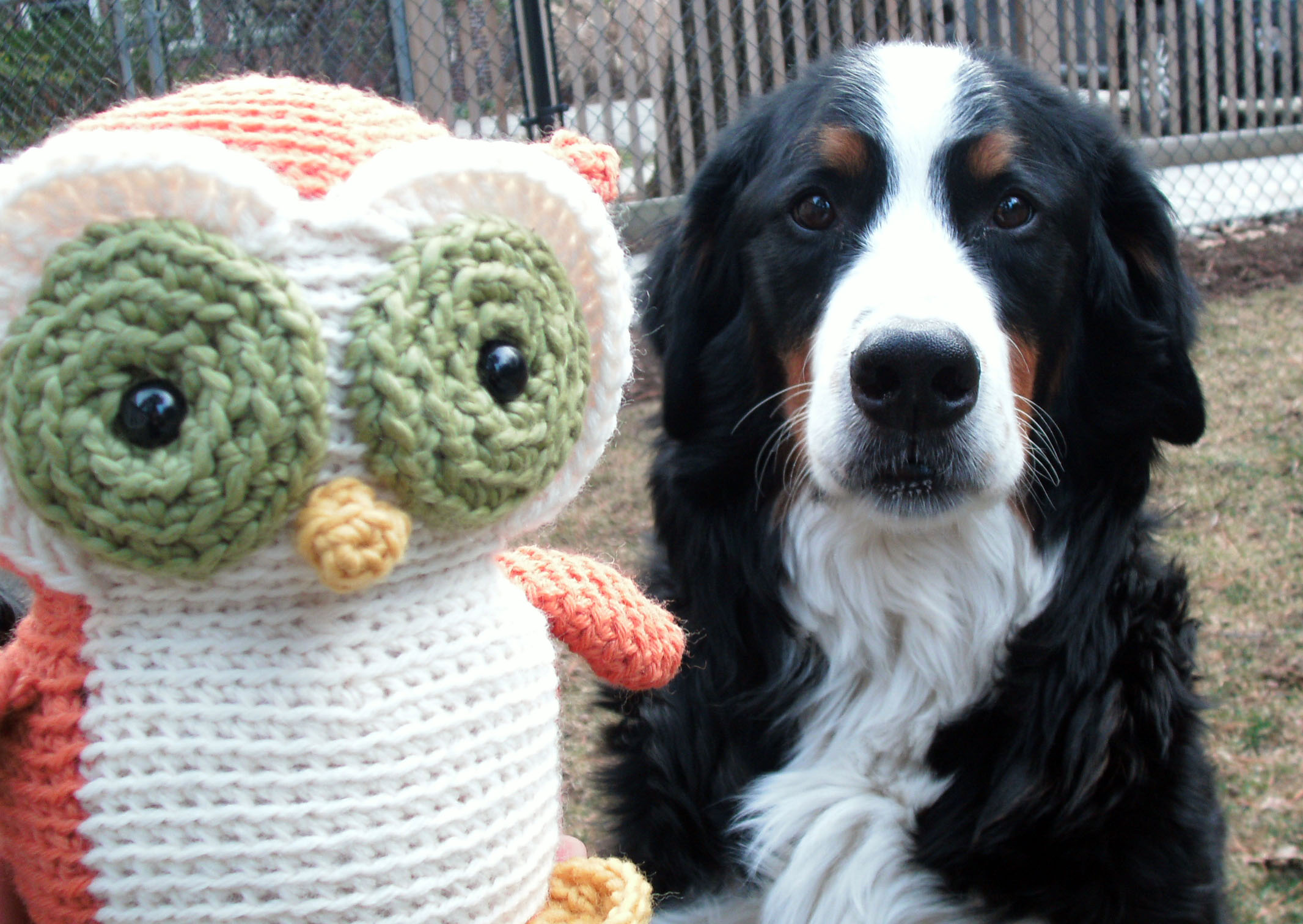
Stacey once snapped a great photo of a friend’s dog and an owl she crocheted.

Her friend was so amazed! She asked, ‘How did you get him to sit still like that?’

And Stacey’s answer was – she didn’t. She just took oodles of photos until she got a good one!

A lot of people seem to think that a photographer snaps the perfect picture and carries on their merry way. In reality, even professional photographers take tons of photos, and only later pick out the best ones. So do the same thing! Take a ton, and weed through them later. It increases your chance of catching that perfect shot!

Tip 5: Edit your Photos

It’s totally okay to edit your photos after you’ve taken them!

Photoshop is the professional standard, but it’s expensive. There are lots of other options! I use GIMP (which is like a free version of photoshop) and there are lots and lots of apps out there to choose from.

I edit almost every photo I take. Even when I take a photo on my white posterboard, I often have to up the exposure a little bit to get it to a true white. Or, in the case of the dog photo (above), Stacey snapped a great picture, but had to crop it so you wouldn’t see the garbage cans on the side.

It’s free, only takes a few minutes and turns your pictures from ‘nice’ into ‘wow’… so try a little editing!

Give it a try!

I’d love to hear if you do any of these photography tips already, or if you’re giving one a try today! I hope to have convinced you that you don’t need fancy lights or a thousand dollar camera to take great project photos!

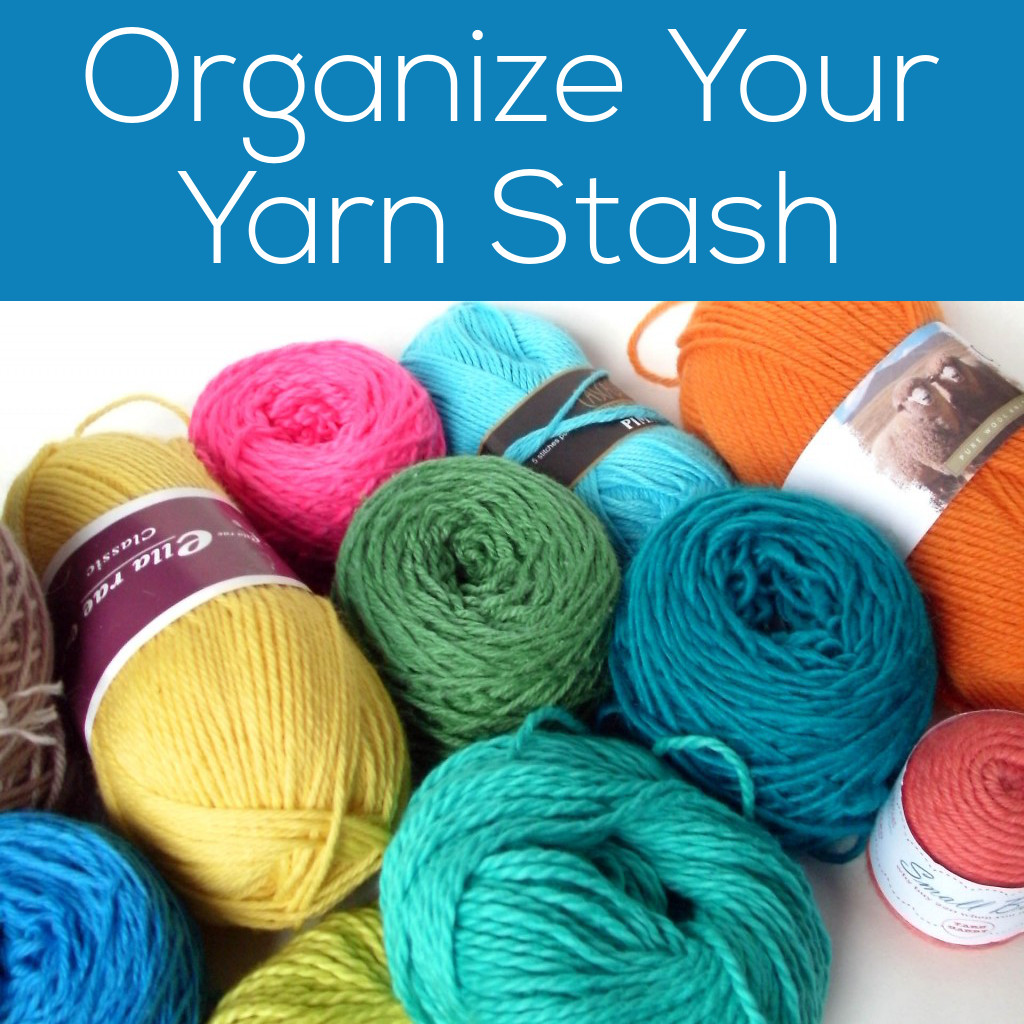
A plan for organizing your yarn stash!

A Plan to Organize Your Yarn Stash - from FreshStitches and Shiny Happy World

Every knitter and crocheter has one… it’s called a ‘yarn stash’. And, if left unchecked, your stash can quickly turn into an unkept mess that just seems to keep on growing (on it’s own, of course!). But don’t worry! I’m here with a step-by-step-guide to organize yarn and get your stash under control.

Finding yarn in your stash is the key to using it

How many times have you bought yarn for a project… only to later discover that you had a very similar yarn at home? That’s because if you can’t find a yarn quickly and easily, you’ll forget that it’s there.

So, organizing your yarn so that you know what you have (and know how to get to it) is key. I’m not going to go into details about a specific organizational system (bins vs. shelves vs. baskets), because you have to find what works for you.

I am going to show you how to go through what you own and get your yarn under control.

Step one: drag it all out and sort it

Now, I know that some of you with larger stashes are rolling your eyes right now. But seriously, how can you know what you have unless you actually get it all out and look at it?

You can’t just say, ‘oh, I know what’s in that bin’… because you probably don’t. So get it all out.

Now that it’s out, sort it into piles. You’ll have to pick categories that make sense to you. Mine are: yarn for ‘real projects’ (i.e. yarns I have multiple skeins of), yarn for one skein projects (usually pretty sock yarn), yarn for custom stuffed animal orders (worsted weight yarns that are partial skeins), scrap yarns, and yarn to get rid of.

It’s important to be honest about your piles. Yarns only make it into my ‘scrap yarn pile’ if it’s a partial skein that I would actually use to make a scrap afghan. Nothing under 20 yards. No laceweight. No eyelash. Be honest with yourself!

Now these piles may take up your entire living room. I know it’s scary… but you’re after something better!

Catalog, wind and store

Now that you’ve divided your yarn into piles, resist the temptation to just put it back on the shelf!

Is some of your yarn tangled? Were you able to see it in its old storage space? If not, it’s time to rethink your strategy. Here’s what I do:

Catalog

Of course, we all fantasize about beautiful shelves that allow us to store pretty skeins in full view. But, many of us don’t have that kind of space, and need to use bins or boxes. So it’s important to take note of what you have.

I love the ‘stash’ tool on Ravelry – it allows you to list the yarn that you have and even list it ‘for sale or trade’ if it’s a yarn that you don’t want anymore.

Wind

If your yarn is in full skeins, then it’s probably behaving itself without getting tangled. However, if you have partial skeins, they have a propensity to get themselves in knots.

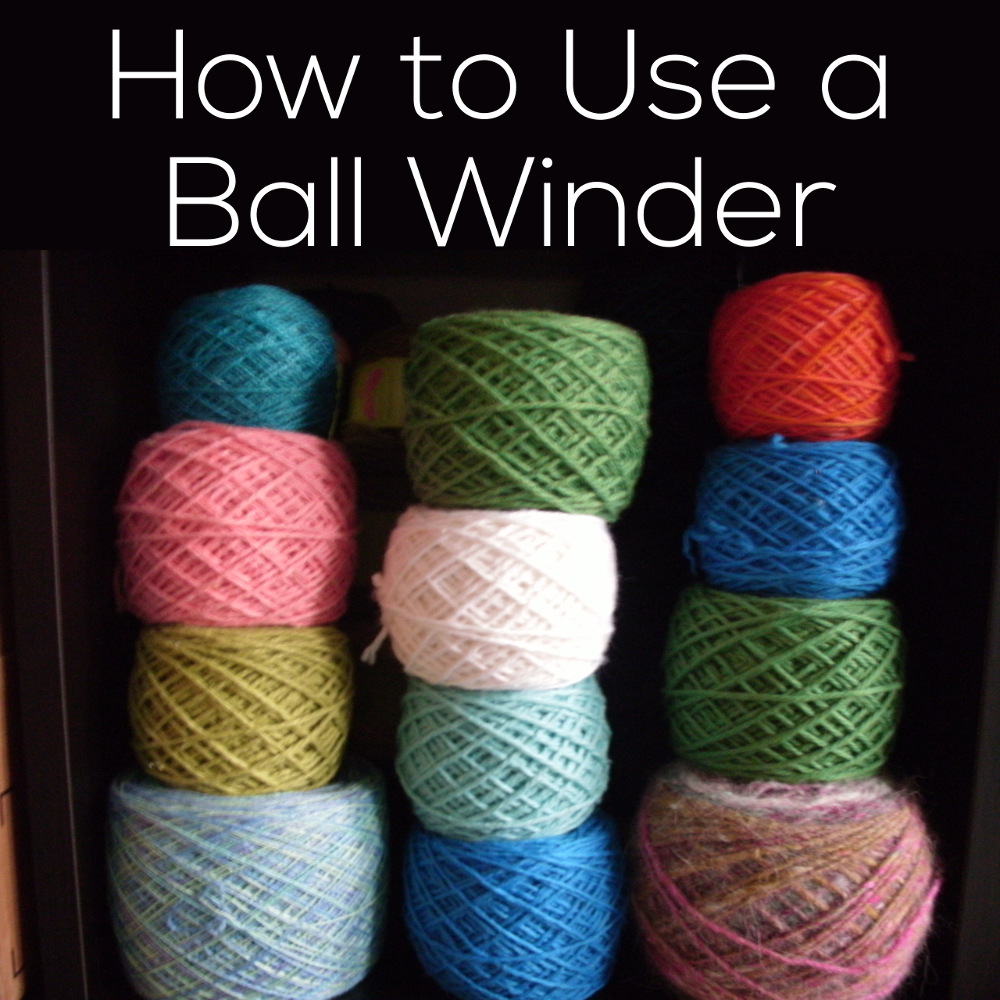
I have a Lacis Ball Winder that I use to wind partial skeins into cakes (see a how-to-video, here). When wound, the yarns stack nicely, and lay in a bin without getting tangled.

Store

NOW that your yarn is neat and cataloged, you can put it back on your shelf!

Make plans

Sure, your yarn looks neat… but don’t stop there! Do yourself a favor and make plans with the yarn while it’s still fresh in your mind.

When I’ve gone through my yarn, I like to match yarn with projects. That way, when I’ve finished a project and am itching to start another… I already have one (that uses yarn from my stash!) set up. That keeps me from buying more yarn on a whim.

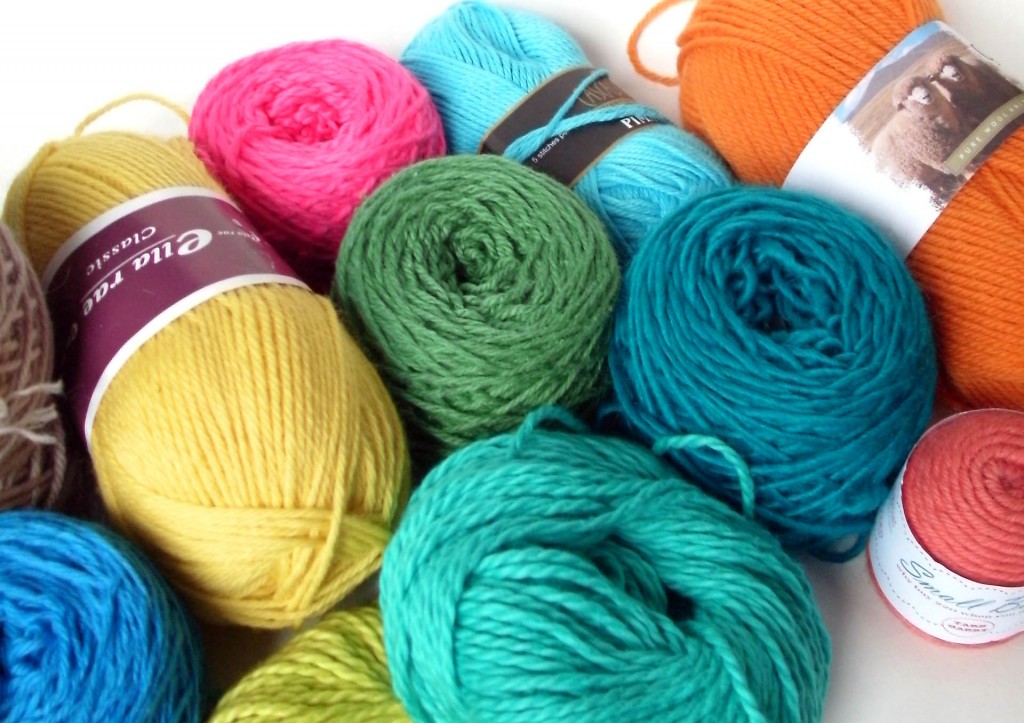
For example, I have 10 skeins of this yarn in a color that just doesn’t flatter me at all:

My plan is to over-dye the yarn in brown and knit a Buttercup. If I didn’t make the plan, I would probably just leave that yarn languishing!

Weigh your yarn for project planning

If you have partial skeins, it can be hard to know how much yarn you have- making it hard to plan a project. A real help is to weigh your yarn. I have an inexpensive digital scale that I use to weigh mystery bits of yarn. By using the information on the ball band, you can calculate the yardage… and plan a project!
Enjoy!

Phew! That was a lot of work… but now you can sit back, knit, and enjoy your beautiful stash!

Want tips for organizing and decluttering your whole craft room? Wendi has a great post here.

How do I rotary cut extra wide fabric?

A couple of months ago I made a video about cutting fabric with rotary cutting tools. I got an excellent question from an anonymous commenter. . .

Hi, I bought fabric for quilting and it is 51 inches selvage to selvage folded…..my question is how do I cut that? Neither my cutting mat or my ruler are long enough.

The answer here is easy to say – kind of tricky to do right. In the video I show you how to fold the fabric in half the long way to cut it. That works with my big mat and long ruler – but what if your tools are smaller?

Well – you fold the fabric in half the long way again. Easy, right? Yes. The trick is that you have to make your folds exactly parallel to each other, so that your cut across the fabric run perpendicular to both of them. Otherwise you’ll get annoying Vs at the folds. There’s no special skill needed for this – you just have to be fussy about getting everything lined up as best you can.

Happy Wednesday!

Best,
Wendi

Applique Wendi (with fabulous hat)

How to use a ball winder

This post contains affiliate links. That means I make a little commission if you buy something after clicking through. All affiliate links are marked with an *.

Today, I’ve put together a little video to show you how to use a ball winder.

What is a ball winder?

A ball winder* is a handy device that allows you to make neat center-pull yarn balls (also called ‘cakes’). They’re a great alternative to hand-winding yarn, and contrary to popular belief, aren’t terribly expensive.

About the Lacis Ball Winder

Specifically, I’m going to show you how to use the ball winder that I own, the Lacis Wool Yarn Ball Winder*. Why this one?

In my opinion, this is the best ball winder for the at-home crafter: it’s inexpensive and very reliable. You can read my full review about the winder, by clicking here.

However, I’ve read some not-so nice things about this winder in online reviews: saying that it doesn’t work properly. Unless the reviewer received a defective model, I think the problems experienced come from improper installation/usage of the ball winder.

So, I’m going to show you how to install, tension and use the winder… and you’ll be a happy camper!

The Video

To view the window in full-screen mode (which is probably easier to see), click the icon in the lower right corner of the insert.

With proper installation and usage, I think you’ll find that your winder works like a dream!

Vibrant handmade crochet toys and patterns from Shiny Happy World.

Here are handy links to all the posts about yarn. . .

Return to the main table of contents for Let’s Learn to Crochet Amigurumi.

Move on to the lessons for the basic crochet stitches.

Happy stitching!

Vibrant handmade crochet toys and patterns from Shiny Happy World.

A Yarn Lover’s Guide to Sydney, Australia

Looking for yarn shops in Sydney, Australia? Then this guide is for you!

I’ve spent a fair bit of time in Sydney, and it’s a beautiful and walkable city. I’ve picked four areas of town that are fabulous for walking around and sightseeing – and they also have some of the best yarn shops in Sydney! In this guide, I’ve included yarn stores, craft stores/markets and shops where you’ll find yarn and exclusively Australian wool products.

I’ve sketched some maps… but you’ll want a ‘real’ map as well, since mine aren’t terribly detailed.

Ready? Let’s get started!

The CBD

The CBD (Central Business District) is what Aussies call their ‘downtown’. On any trip to Sydney, you’ll likely find yourself wandering through this district of beautiful buildings and shops. Subway stations are plentiful, but if you’re making a special trip, then Town Hall is probably your best bet for the yarn shops.

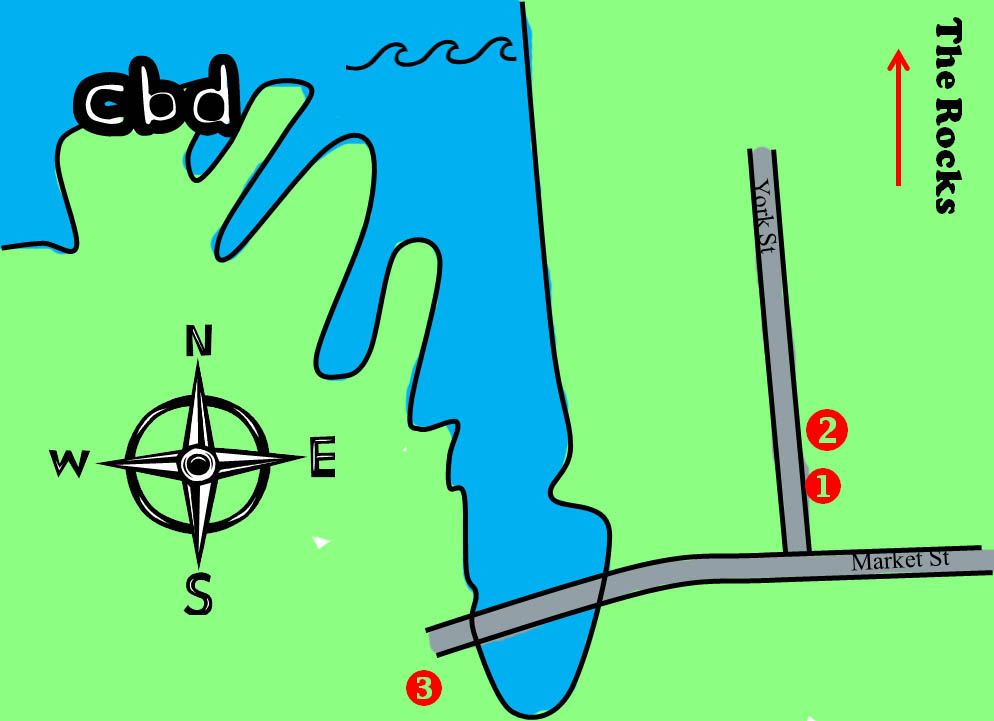
map showing yarn shops in Sydney, Australia - the CBD

1. Morris and Sons, 50 York St. Morris and Sons is a cross between an LYS (local yarn store) and a big box store. They have a couple of stores nationwide and their own brand of (reasonably priced) yarn. They also carry loads of imported fine yarns and have a table for sitting & stitching. Click here to read a full review.

2. Lincraft, 68 York St. Lincraft is comparable to a JoAnn’s or Hobby Lobby in the US: lots of craft goodies, and mediocre (but cheap) yarn. You may not find much yarn worth putting in your suitcase, but it’s amazingly good fun to look around at all the supplies. It’s stocked slightly differently than an American shop (for example, you’ll find a hat-making aisle and kangaroo scrapbooking supplies), so I doubt you’ll walk out empty-handed.

3. Darling Harbour Souvenir shops. Walk west along Market Street, and you’ll head over to Darling Harbour, which is full of souvenir shops. I wouldn’t usually recommend going to these (usually junky) shops, but this is where you’re most likely to find scarves and hats made from possum yarn. Possum yarn is unique to the Australia/New Zealand region (mostly from New Zealand, where they’re an introduced species threatening the native wildlife), and is incredibly warm and soft. It’s very difficult to find the yarn, so a lovely possum scarf might be your best bet.

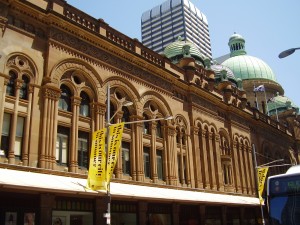
Other sights. The Queen Victoria Building is the main ‘place to shop’ in the city. Wander a little further to Galleries Victoria and stop by Kinokuniya– a fabulous Japanese book store with an unbelievable selection of craft (and knitting and crocheting) books.

Walk north up George Street, and you’ll end up at our next stop…

The Rocks

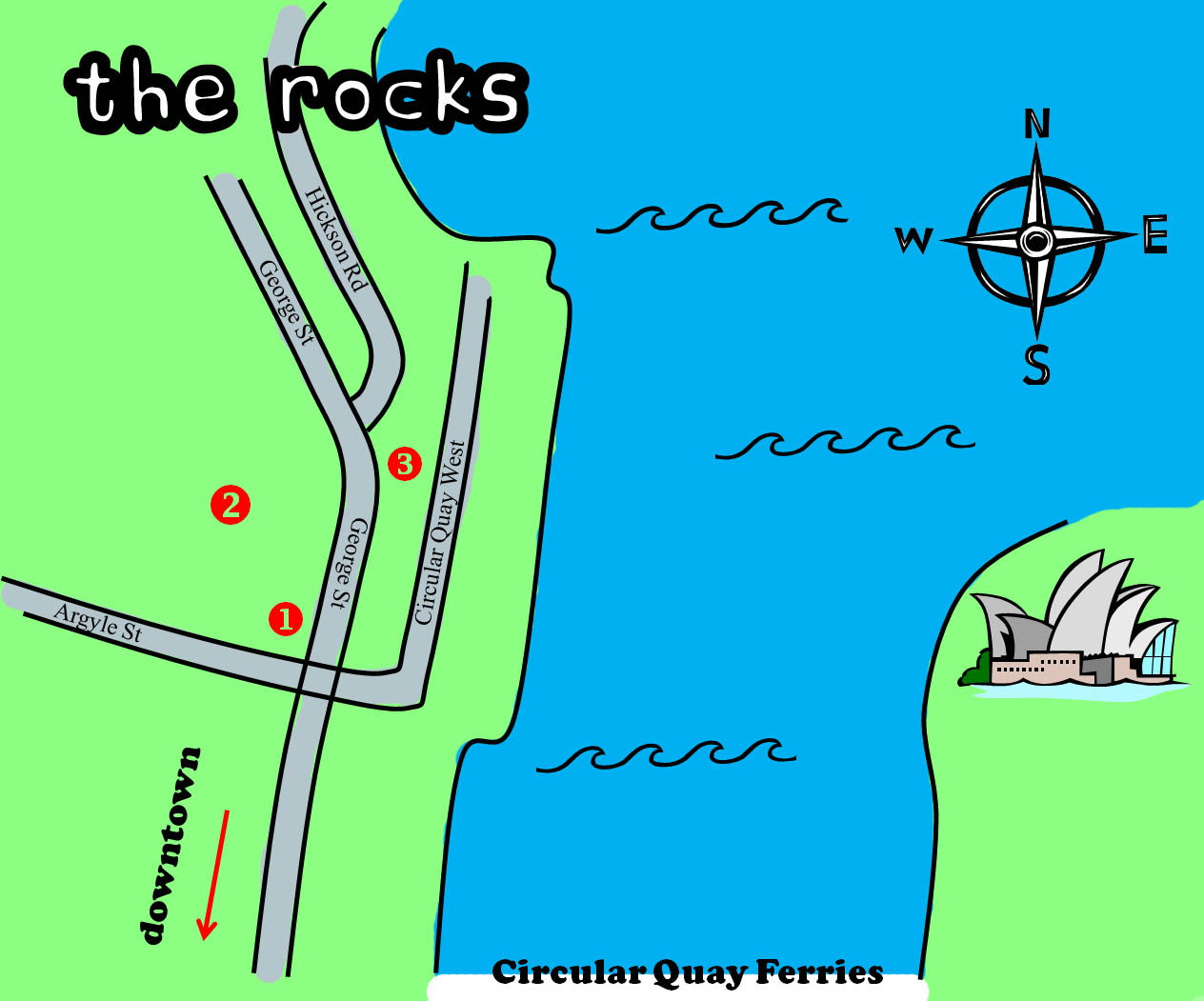
map showing yarn shops in Sydney, Australia - The Rocks neighborhood

The Rocks is sorta touristy, but sorta artsy and hip… and it’s one of my favorite districts in town.

1. The Sheep Shop Okay, you’re going to be mad at me, but I don’t actually know the name of this place! But, it’s a genuine sheepskin store, not some wacky souvenir shop. It’s on the left, and you’ll see it as you’re walking up George Street from Circular Quay (pronouced: Circular KEE). This shop occasionally stocks possum scarves and accessories (see point 3, above) and lots of wonderful sheepiness. Come here for the real thing.

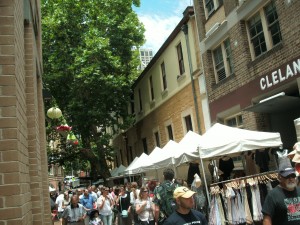
2. The Rocks Market. The market is held every Saturday and Sunday, and is a great source for handmade items. I haven’t yet seen a stall full of handspun yarn, but it would fit right in.

3. Craft NSW, 104 George St. This store is a lovely place full of work made by local artisans. I can’t guarantee it will always be in stock, but I’ve spotted some great local handspun yarn for sale. Click here for a complete review of the shop.

Other sights. Hands down, The Rocks is the best place to have your photo taken with the Opera House in the background. Just walk up to the water and you’ll see what I mean (it’s where I took the photo above). This is also the home of The Museum of Contemporary Art, which is worth a visit if you have the time. On the food scene, you’ll want to check out Pancakes on the Rocks (for yummy crepes) and The Rocks Cafe and have a Kangaroo Burger (the tourist favorite) or a plain ‘ol burger with a slice of Beet (the Aussie classic).

Mosman

Mosman is sorta like the ‘well-to-do’ district: filled with lovely shops and beautiful cafes. To get to Mosman, I’d recommend the ferry from Circular Quay (even though buses do run): it’s a fantastic view of the city!

Mosman is also home to my one of my favorite yarn shops in Sydney: Mosman Needlecraft, 529 Military Road. It’s a well-stocked shop with lots of goodies – and I always like checking out the needlepoint (a rarity in the US)! Click here for a full review.

Other sights. I happened upon in.cube8r Gallery on my last trip there: it’s a great gallery filled with work from local artisans. There was even an amigurumi artist – steal my heart! It’s also worth having a walk up and down Military road, and maybe down a street to get to the water. Beautiful.

Newtown

Newtown is the district right next to Sydney University, and so has a ‘college-town’, hippie feel to it. It’s also home to Sydney’s newest yarn store – A Coffee and a Yarn, which makes it well worth the visit.

I like to walk into Newtown from the city because my in-laws live nearby (City Road turns into King St), about a 45 minute walk end-to-end. If you’d prefer, take the subway to the Newtown station, placing you right next to the yarn shop!

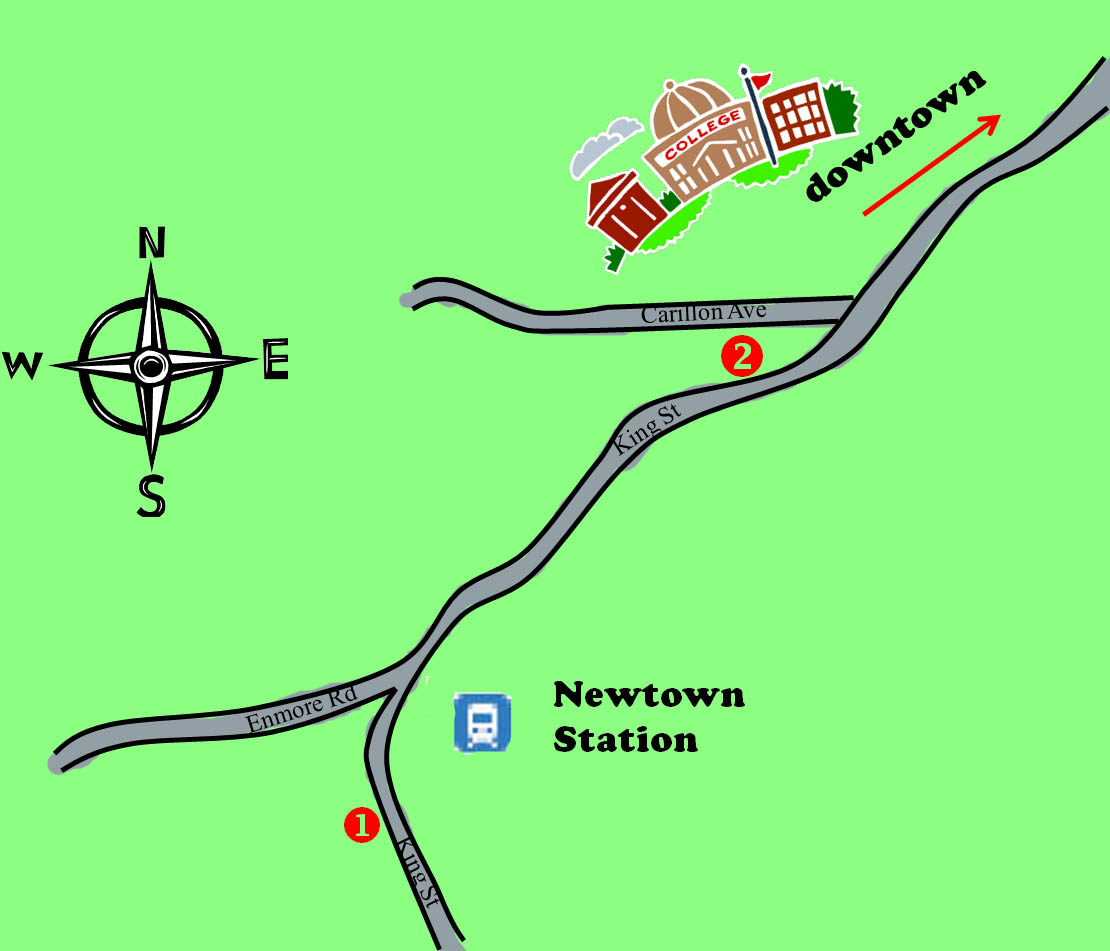
map showing yarn shops in Sydney, Australia - The Newtown neighborhood

1. A Coffee and a Yarn. This shop opened last year and is as much like an American LYS as I’ve seen in Australia. Classes, tables for sitting, nice yarn and even a coffee bar!

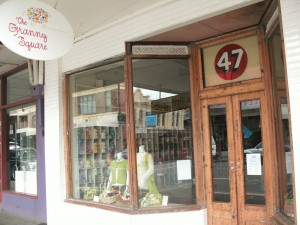
2. The Granny Square. If you’re walking in from the city, you’ll see two yarn shops on your right (one picture, The Granny Square). They weren’t open when I was passing by, but if you’re on a yarn adventure, you might want to make the stop!

Other sights. I love Newtown for its yummy Asian food… and almost every noodle shop you stop into is wonderful! It’s also the place to find some rarer cuisines, like Nepalese food.

It’s your turn!

Planning a visit? Already been? Let me know if you spy any new yarn shops Sydney! I’d love to hear how your trip went!

How many strands of embroidery thread should I use?

How Many Strands of Embroidery Thread Should I Use?

I’ve gotten several emails lately from people asking how many strands of embroidery thread they should be using – and how to separate the strands.

How Many Strands of Embroidery Thread to Use

First let’s tackle the question of how many strands to use. It all depends on your project! Think of it like choosing a fat marker or a thin marker. If you’re drawing something pretty small, with lots of fine details, you’re going to use a thin marker/fewer strands of thread.
If you’re drawing something big and bold without a lot of fussy details, you’d choose a fat marker/more strands of thread.

But how do you know how many strands? Well – that involves a bit of trial and error, and a willingness to pick out your stitches if needed. Take your best guess. Stitch an inch or two and then take a look. If I think it needs to be fatter, I’ll unpick, add an extra strand, and try again. If I think it needs to be thinner I’ll unpick, take away a strand, and try again.

Note: I tell you how many strands to use in the color and stitch guide of all my embroidery patterns. πŸ™‚

Of course – save all the strands you separated out! You can still use them.

How Do You Separate Out Just a Few Strands of Floss?

Now – about separating those strands.  First make sure you’re using the right kind of embroidery thread. Click on the picture at the top of the post. I loaded up a large file so it should fill the whole screen when you click and let you look very closely.

The thread on the right is called embroidery floss (or thread) – or sometimes stranded cotton. It’s what I usually use. It’s 6 strands of thread that you can separate into as many as you need.

The thread on the left is called perle cotton, pearl cotton, or sometimes craft thread. See how it’s twisted together? You can’t undo that – not without making an unholy mess. It’s lovely to stitch with – and you can buy it in several different thicknesses – but you can’t alter the thickness yourself. My favorite is Sulky 12 wt Petites – the equivalent thickness of 2 strands of regular DMC embroidery floss.

The tricky thing is that these two kinds of thread are often displayed together in the same section of the store. Luckily, it’s easy enough to tell the difference if you know what you’re looking for.

So – now that you have the right kind of thread – how do you separate it without ending up with a snarl?

Don’t cut your thread too long. The experts say it should be no longer than the distance from the tips of your fingers to your elbow – but I confess to cutting mine a bit longer than that.

Now – hold it up in the air so that the whole length of thread is freely dangling down. Tease out the number of strands you want and slowly pull them away from the mother strand. The strands are very lightly twisted together so there will be a bit of untwisting as you pull, but if you pull slowly it shouldn’t tangle.

Stitch away!
Vibrant handmade crochet toys and patterns from Shiny Happy World.

Here are all my posts about knots.

Before you knot that thread you need to know how much to use, so here’s one more post that doesn’t really have a better place to live. πŸ™‚ How Many Strands of Thread Should I Use?

Return to the Learn to Embroider main Table of Contents.

Move on to the lessons for the four most basic embroidery stitches.

Vibrant handmade crochet toys and patterns from Shiny Happy World.

Sulky Sticky Fabri-Solvy – Embroidery Pattern Transfer and Stabilizer

I was browsing through the Sulky website recently and I saw Sulky Sticky Fabri-Solvy – a stabilizer that I’ve never seen in a store or even heard of. It sounded amazing, but it was kind of expensive and I thought it might be too good to be true so I ordered just one package to test it out.

I AM HOOKED!

I can’t get over how tremendously, perfectly useful this stuff is! Especially for those of us who buy digital patterns! It’s so amazing that I did a video just for this one product. It replaces everything I normally use. Everything!

See this video on how to transfer embroidery patterns? And this one about embroidering on stretchy fabrics? And this post about removing stabilizer? I now use Sulky Sticky Fabri-Solvy instead of all the products I showed you in those old videos. It works on light fabrics, dark fabrics, napped fabrics, and stretchy fabrics. It’s MAGIC!

I say it all in the video – but it’s worth saying here again. Here’s what’s so great about it. . .

  1. It’s 8 1/2 x 11 inch sheets that can go through your inkjet printer or a photocopy machine. (Update – it now goes through a laser printer as well!) No more tracing patterns. Ever! Tracing patterns is my least favorite part of an embroidery project and I Will Never Do It Again!
  2. Peel off the paper back and stick your pattern to your fabric. It sticks REALLY well, but doesn’t leave even a trace of adhesive on your thread or needle. (Update – I’ve since learned that if you leave your embroidery sitting in a hot car in the summer, it will affect the adhesive and make it leave a slight gummy residue on your needle as you work. Yuck! But if you use a little Thread Magic conditioner on your needle and thread it eliminates that residue completely. Yay!)
  3. Stitch right through the pattern and fabric. The pattern sheet actually stabilizes your fabric, making your stitching even neater. And it works on stretchy fabrics too!
  4. Dunk your finished embroidery in water and swish it around for a minute or two and every trace of the stabilizer dissolves away.

Watch how it works. . .

(You can find that You Are My Sunshine embroidery pattern here.)

I love this stuff! One package contains 12 sheets and costs $14.99. That works out to a little bit more than $1 per sheet. At first I thought that was a little on the pricey side and I’d just use it on more complicated patterns, but now that I’ve used it on a few projects I’m totally hooked. Pay a buck and I don’t have to trace the pattern, my fabric is beautifully stabilized, it doesn’t matter if I go off the lines a bit, and it rinses away in minutes? Yes please!

I am all about tools and techniques that make my crafting easier and more enjoyable. This is supposed to be fun – right? πŸ™‚

You can buy the stabilizer here. You guys are going to love this stuff!

Vibrant handmade crochet toys and patterns from Shiny Happy World.

Here are all my posts about working with patterns.

Pattern Sources

How to Resize a Pattern

Return to the Learn to Embroider main Table of Contents.

Move on to the posts about knots. Yes – a whole section about knots. πŸ™‚

Vibrant handmade crochet toys and patterns from Shiny Happy World.

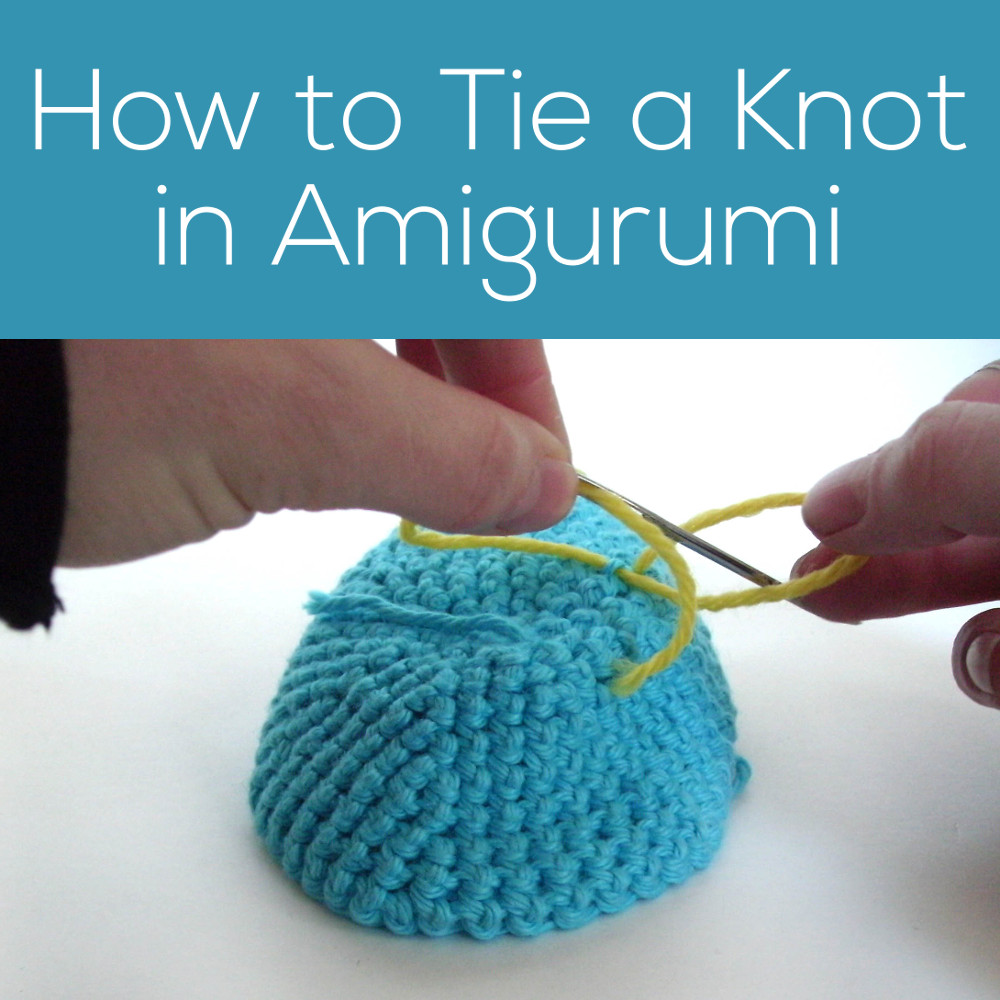
How to tie a knot in amigurumi

How to Tie a Knot in Amigurumi - a tutorial from Shiny Happy World and FreshStitches

It’s another Tip Tuesday! Today, I’m going to show you, step-by-step, how I tie a knot in my amigurumi to secure limbs.

My preferred method of tying knots in amigurumi is to attach the limbs to the body before the body is stuffed, so that you can tie the knot on the wrong side of the work.

How to tie a secure knot

You don’t want your animal’s arm/leg/whatever to fall off, so it’s important to tie a secure knot. Here’s how I do it:

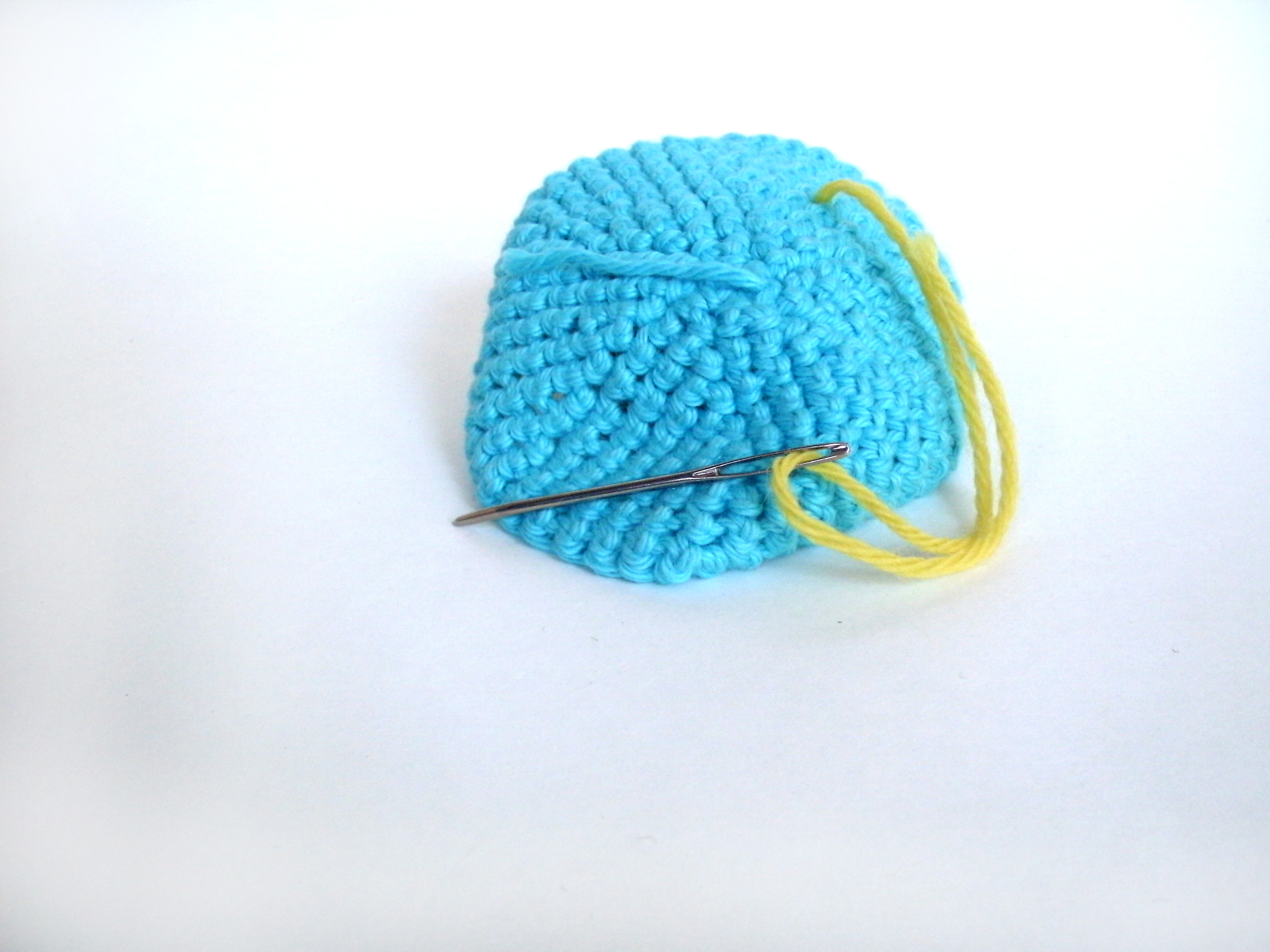
The knot begins after you’ve already done your sewing of the limb to the body. Once you’ve done that, pull your yarn (already on a tapestry needle) to the wrong side of your work:

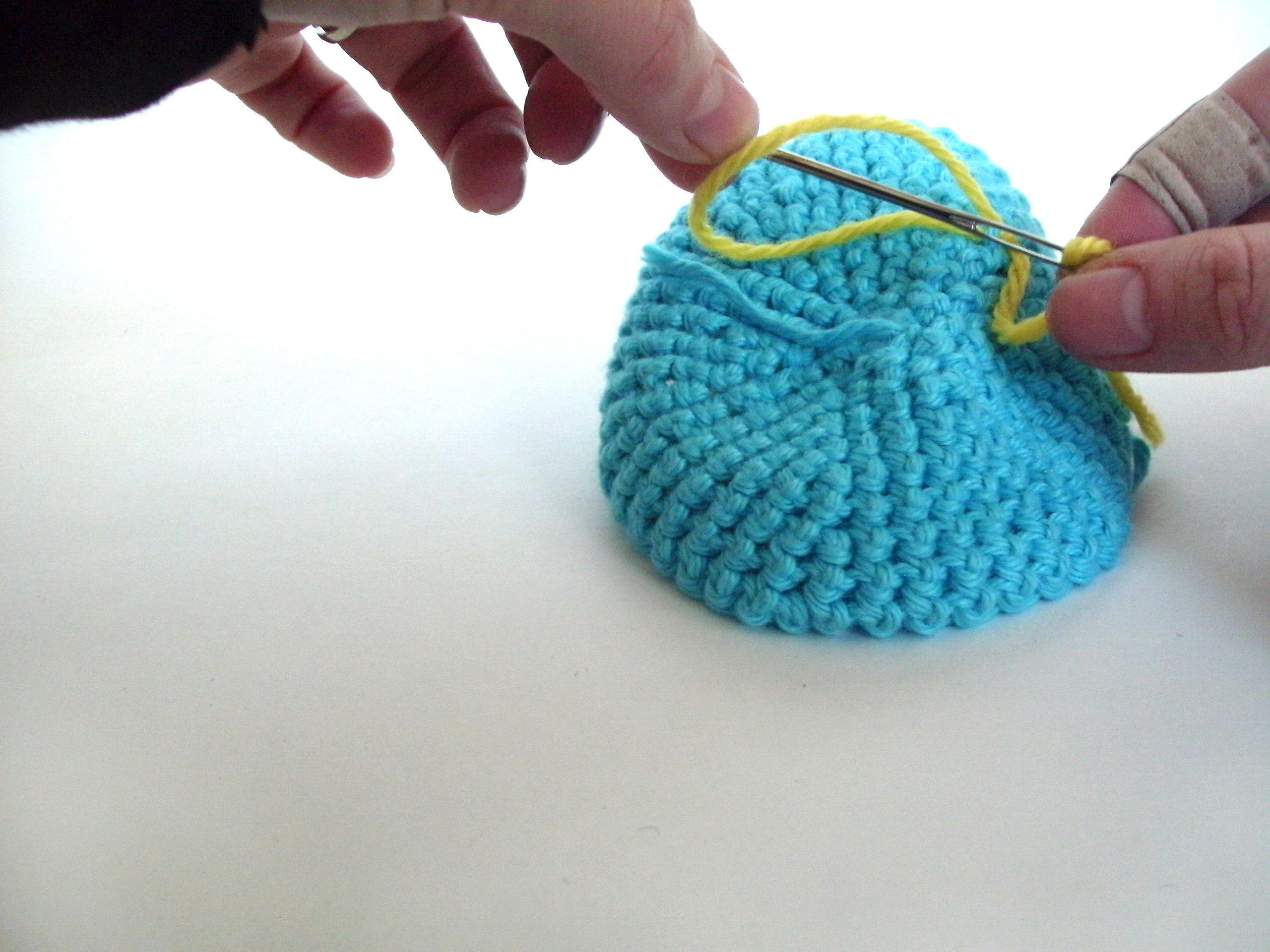
Insert your tapestry needle (from right to left) into a stitch of the body. I like to pick a stitch close to where the yarn has been pulled through to the wrong side, so that there isn’t extra yarn flying around:

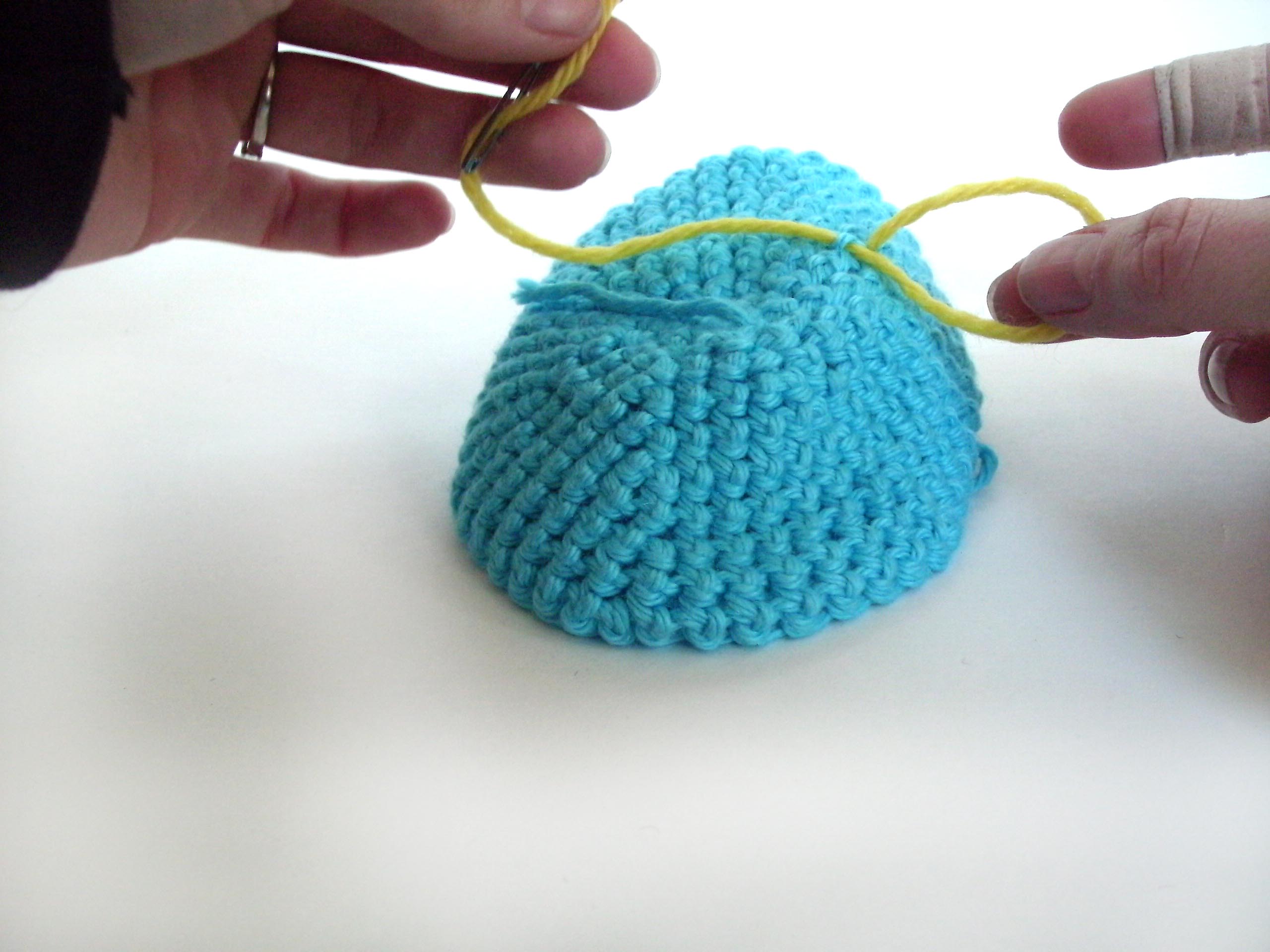
Now, pull the tapestry needle with your left hand (not all the way!), and stick your right index finger in the loop that forms on the right:

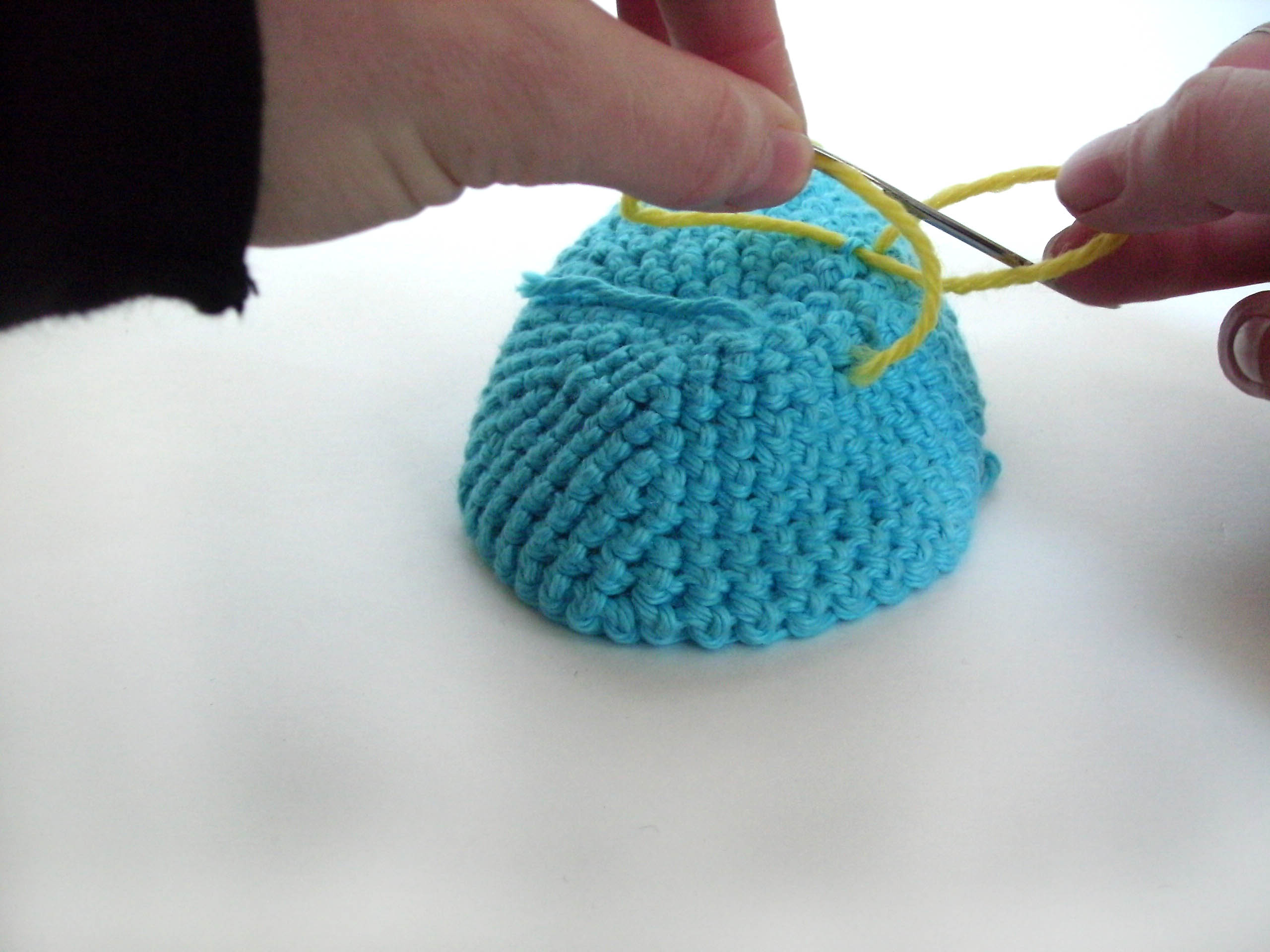
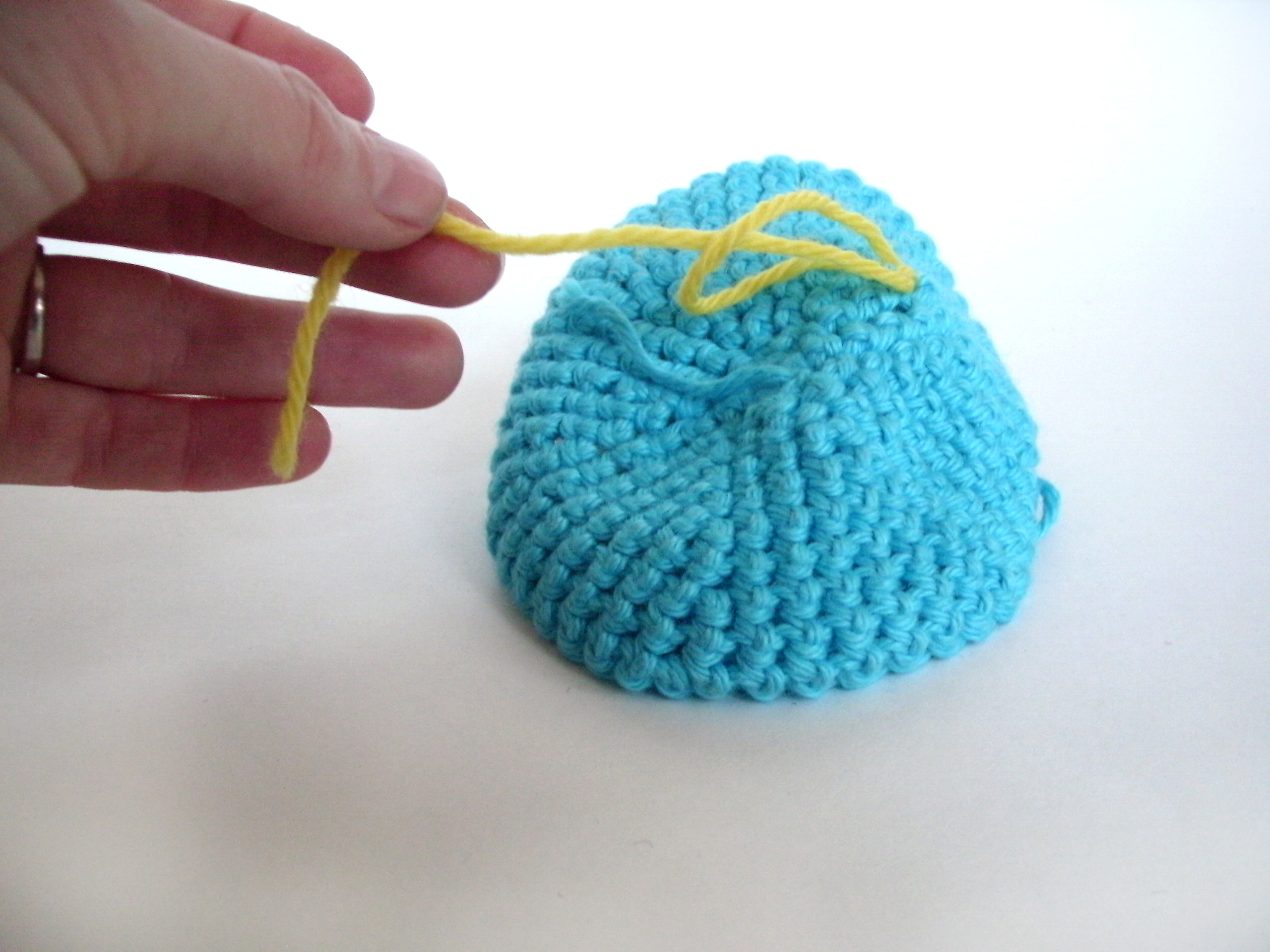
Insert your tapestry needle (from left to right) into the loop that the index finger on your right hand has been holding open:

Hold onto the tapestry needle with your right hand (taking it out of the loop it was holding), and stick your left index finger into the new loop that has formed on the left:

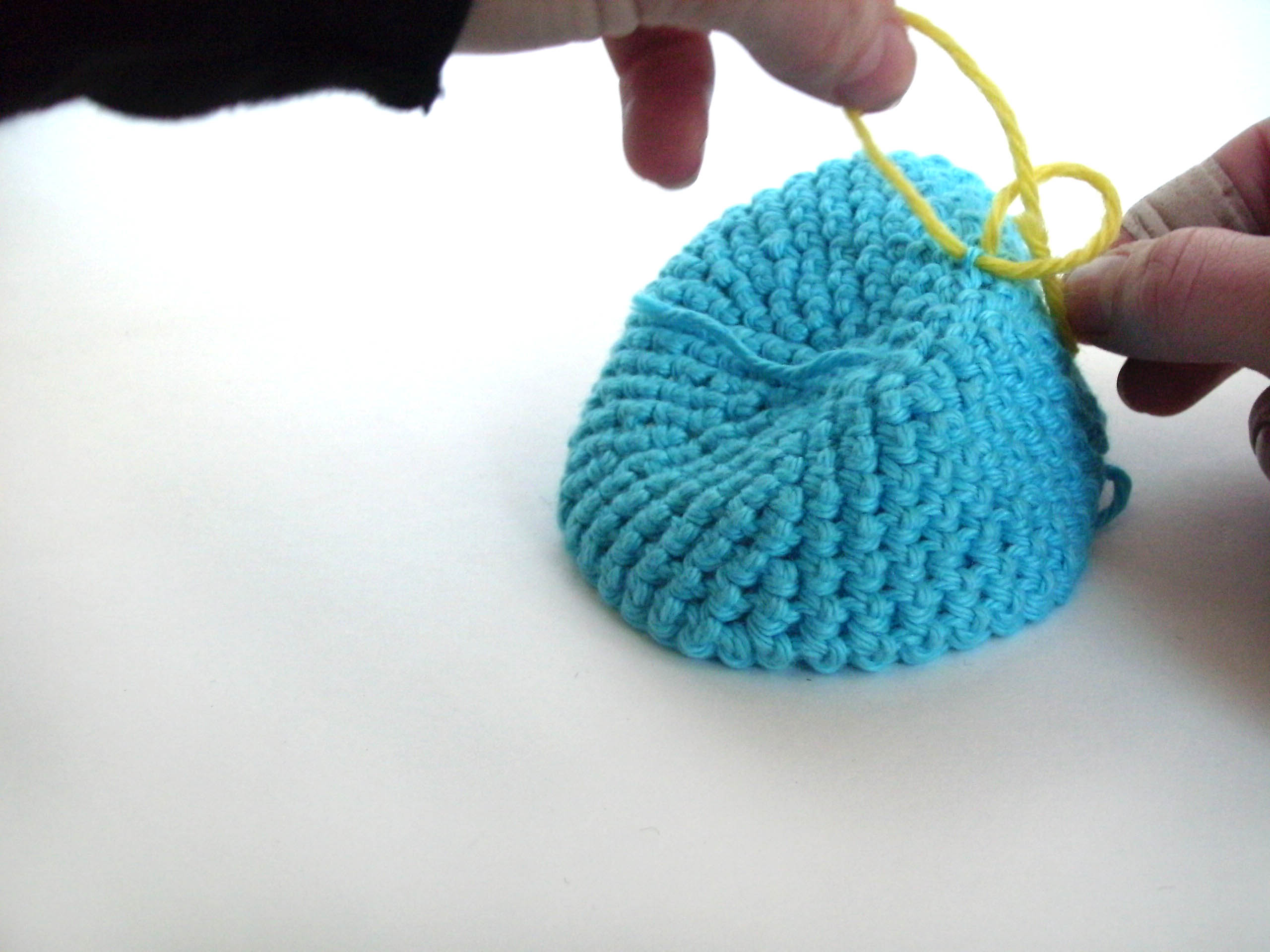
With your left hand, pull on the loop. This will cause the old ‘right-side’ loop to shrink:

You’re almost there! Now, insert the tapestry needle (from right to left) into the loop that your left hand is holding:

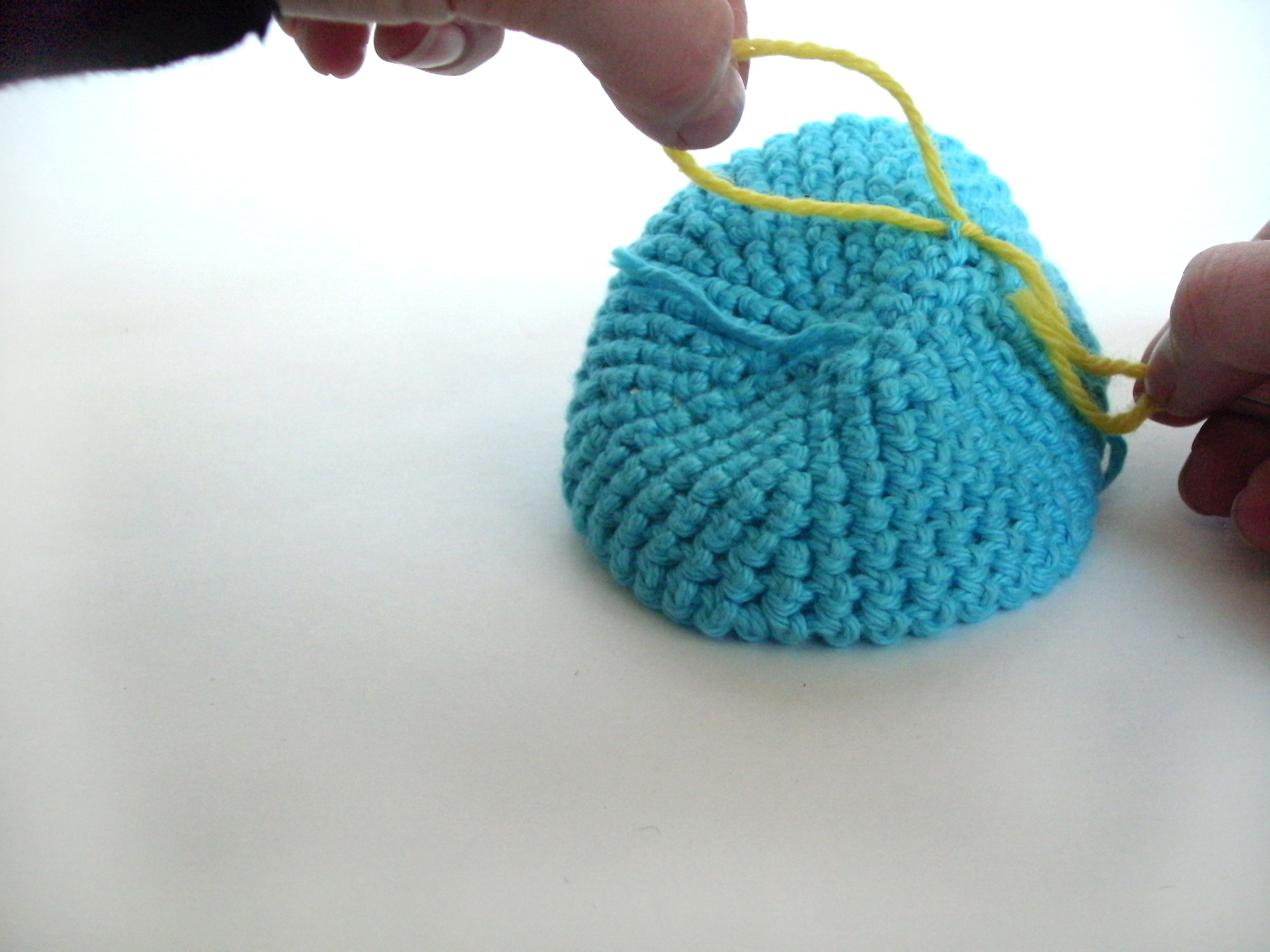
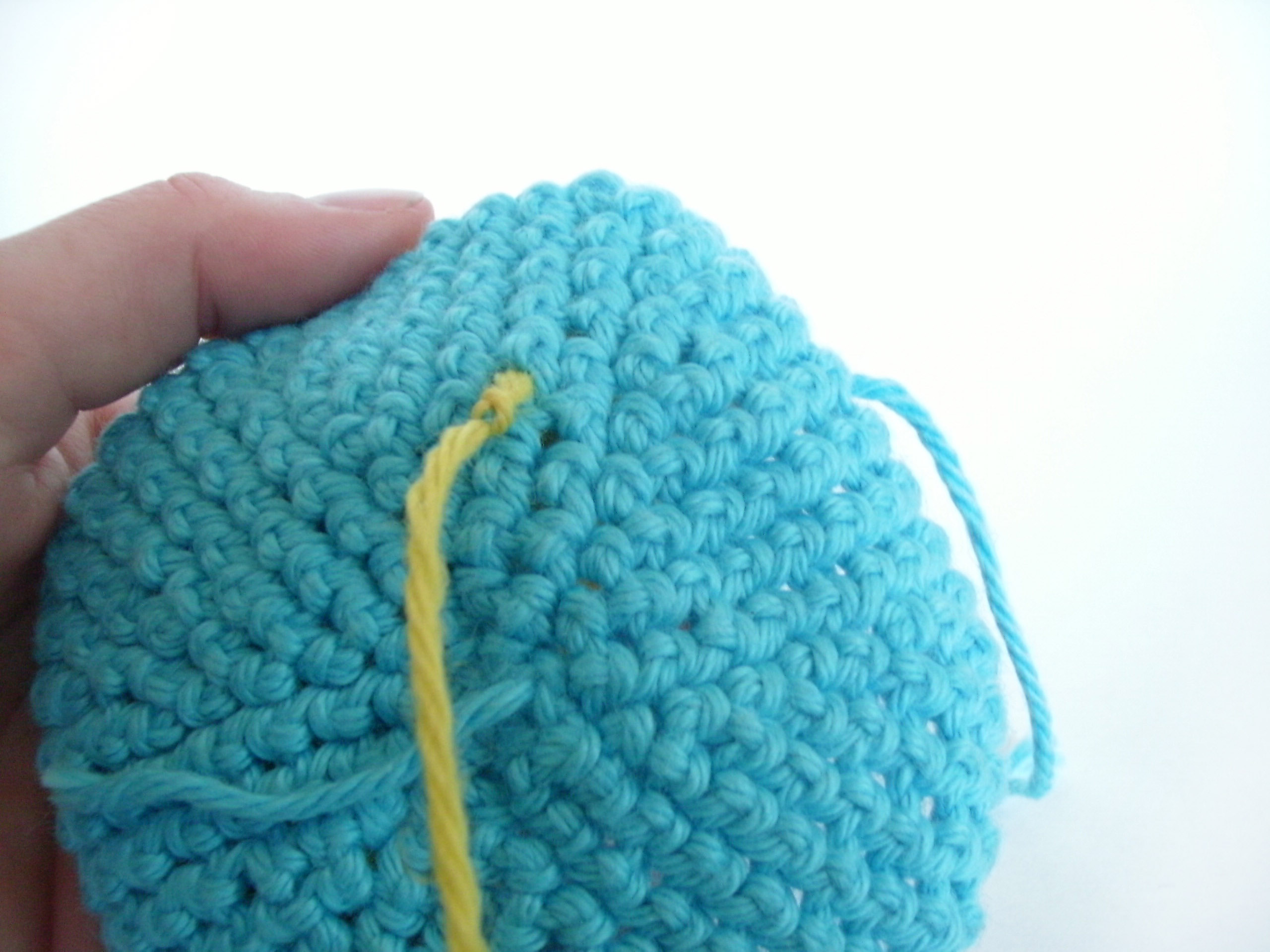
Now, you want to pull the knot snug. Pull the yarn (you can remove the tapestry needle if you’d like):

And you’re done!

It looks a little complicated at first, but once you do it a few times, it becomes second nature! And this trick results in a firm and secure knot… gotta love that!

Vibrant handmade crochet toys and patterns from Shiny Happy World.

Here are handy links to all the posts about closing up the stuffing opening and fastening off in amigurumi. . .

Return to the main table of contents for Let’s Learn to Crochet Amigurumi.

Move on to the lessons for attaching parts.

Happy stitching!

Vibrant handmade crochet toys and patterns from Shiny Happy World.